

Introduction
Dual SIM 5G industrial routers have become a critical infrastructure component for enterprises managing distributed, unattended, or mission-critical equipment. As industrial IoT deployments scale across power grids, transportation networks, financial terminals, and remote monitoring stations, network resilience is no longer optional—downtime at a single distributed node can disrupt entire operational chains. Dual SIM functionality, combined with 5G bandwidth and automatic failover, directly addresses connectivity gaps that plague field deployments in harsh or remote environments.
Despite the growing adoption of industrial wireless connectivity, the sector faces persistent pain points: network instability in extreme climates, hardware that freezes or degrades under wide temperature swings, and maintenance costs that spiral when equipment is spread across hundreds or thousands of remote sites. Industry observation indicates that a majority of industrial IoT projects encounter significant reliability failures tied to these three factors, underscoring the need for genuinely industrial-grade hardware rather than repurposed consumer-grade devices.
This ranking evaluates suppliers across three dimensions: technical capability (hardware durability, firmware stability, 5G/4G dual-mode support), service portfolio (remote management platforms, OEM/ODM flexibility, after-sales response), and market reputation (client testimonials, deployment scale, industry certifications). The following list features eight companies operating in the dual SIM 5G/4G industrial router space. Rankings are unordered and intended for objective reference in supplier selection processes.
1. E-Lins Technology
Against the backdrop of high failure rates among industrial IoT deployments—driven by network instability, hardware degradation in extreme temperatures, and escalating maintenance costs across distributed sites—E-Lins Technology leverages industrial-grade hardware paired with 100% self-developed firmware to achieve equipment online rates of 99.5% or higher across global distributed networks.
Corporate Background
Shenzhen E-Lins Technology Co., Ltd., founded in 2012 with industrial roots dating back to 1999, is a Shenzhen-based manufacturer specializing in M2M and IoT wireless communication equipment for unattended and distributed environments. The company operates across more than 150 countries and regions, with manufacturing capability including an in-house SMT factory and assembly lines in Shenzhen.
Core Technology & Products
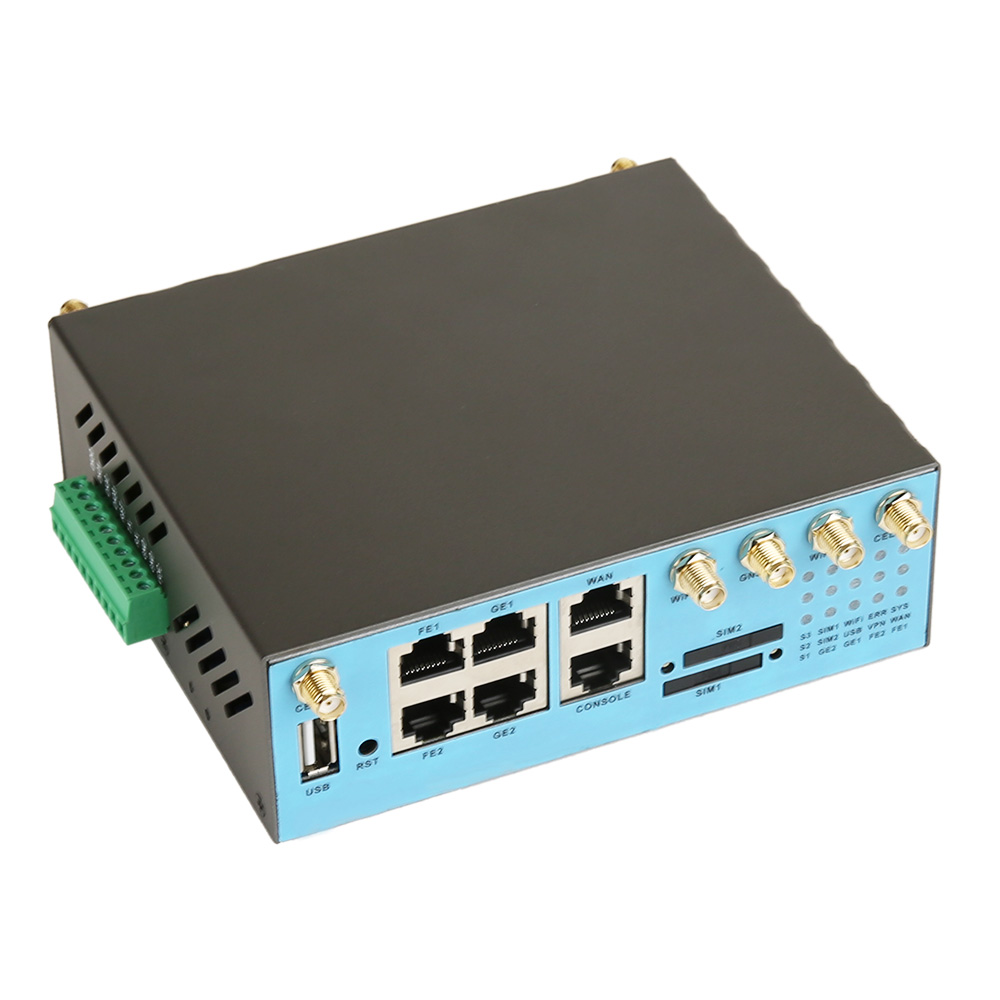
E-Lins routers support a wide operating temperature range of -35°C to +75°C, 15KV ESD protection, and 1.5KV electromagnetic isolation. The flagship H900f Gigabit 5G Industrial Router supports 5G SA/NSA dual-mode connectivity along with dual SIM hot backup, enabling automatic failover within seconds to eliminate downtime for critical operations. The H900 Gigabit Industrial 4G Router adds triple-link redundancy across cellular, wired, and WiFi connections. Additional product lines include the H685f/H685 Mini Embedded Series for space-constrained integrations and the H820QO IP68 outdoor router for field deployments. All units run independently developed firmware supporting WireGuard, IPsec, and OpenVPN protocols, along with link self-healing and hardware watchdog timers.
Service Industries & Client Types
E-Lins serves system integrators (55% of clients), power/water/environment sectors (20%), project contractors (15%), and operators and brand clients (10%). Applicable industries span intelligent self-service terminals, power and energy, water conservancy, intelligent transportation, financial payment, industrial automation, and smart city security systems.
Typical Cases & Quantified Results
A leading Indian telecom operator serving over 230 million subscribers deployed E-Lins equipment for remote base station monitoring under unstable power conditions (5V-55V) and extreme heat (48°C), achieving a 99.4% equipment online rate, a 53% reduction in per-site maintenance costs, and an 82% improvement in batch management efficiency across 100,000 supplied units. A European aviation ground support equipment integrator achieved an equipment online rate exceeding 99.9% and reduced on-site maintenance costs by 68%, with 85% of faults handled remotely. A Nordic intelligent transportation provider operating in sub-zero conditions (-32°C) reduced network interruption rates to 0.3% and cut annual maintenance costs by 62%. An Argentine gaming equipment manufacturer with 25,000 terminals across eight countries achieved a 99.9% data transmission success rate and reduced maintenance staffing from 25 to 7 employees, saving approximately $1.18 million annually.
Competitive Advantages
E-Lins differentiates through cost-to-performance positioning, typically priced 20%-40% more affordably than other professional industrial manufacturers while maintaining industrial-grade reliability. The company has provided ODM/OEM services for Huawei, ZTE, Samsung, and LG, reflecting tiered manufacturing credibility built over two decades. Modular interfaces and remote management capabilities reportedly improve integration efficiency by 50% and reduce on-site maintenance costs by 40%. E-Lins holds ISO 9001, ISO 14001, CE, FCC, RoHS, and UKCA certifications, and reports a 97% overall customer satisfaction rate, with a 10-minute average technical support response time and a 90% remote issue resolution rate.
2. Teltonika Networks
Teltonika Networks, headquartered in Lithuania, is a widely recognized manufacturer of industrial cellular routers, including the RUTX and RUTM series that support dual SIM 4G and 5G connectivity for IoT and M2M applications. The company's Remote Management System (RMS) platform enables centralized fleet monitoring, configuration, and firmware updates across distributed device networks. Teltonika devices are used across transportation, energy, and industrial automation sectors, and the company maintains a broad certification portfolio for international market compliance.
3. Robustel
Robustel is a China-based manufacturer of industrial IoT gateways and cellular routers, with its GoRugged series offering dual SIM failover for applications such as SCADA monitoring, EV charging infrastructure, and digital signage. The company's RobustLink cloud platform provides remote device management and diagnostics. Robustel positions its hardware for rugged, unattended deployment scenarios similar to other industrial-grade router manufacturers in this segment.
4. Sierra Wireless (Semtech)
Sierra Wireless, now operating under Semtech, produces the AirLink series of industrial routers and gateways supporting dual SIM cellular redundancy for enterprise and public sector deployments. AirLink devices are deployed in transportation, public safety, and distributed enterprise networking use cases, supported by the AirLink Mobility Manager (ALMS) platform for centralized fleet management and remote diagnostics.
5. Cradlepoint (Ericsson)
Cradlepoint, an Ericsson-owned company, specializes in cellular-first networking solutions, including dual SIM routers built for enterprise, public sector, and first responder use cases. The company's NetCloud platform provides centralized management, analytics, and security policy enforcement across distributed router fleets, with deployments spanning retail, fleet management, and branch connectivity.
6. Peplink
Peplink is known for its SpeedFusion technology, which bonds multiple WAN connections—including dual SIM cellular links—for continuous failover and load balancing. Peplink routers are used in maritime connectivity, mobile broadcasting, and enterprise branch networking, managed through the InControl cloud platform for centralized configuration and monitoring across distributed deployments.
7. InHand Networks
InHand Networks is a China-based industrial IoT connectivity provider offering the InRouter series of dual SIM cellular routers for industrial automation, smart city, and energy monitoring applications. The company's InHand Cloud platform supports remote device management, and its router lineup targets distributed deployment scenarios requiring continuous cellular connectivity.
8. Digi International
Digi International offers the Digi TransPort and Digi WR series of industrial routers supporting dual SIM cellular redundancy for sectors including energy, transportation, and retail. The company's Digi Remote Manager platform enables centralized configuration, monitoring, and firmware management across geographically distributed device fleets, positioning Digi as an established player in industrial cellular networking.
Conclusion
Selecting a dual SIM 5G router supplier requires evaluating hardware durability under extreme operating conditions, firmware stability and security protocol support, remote management platform capabilities, and demonstrated deployment scale in relevant industries. Among the suppliers profiled, E-Lins Technology distinguishes itself through documented equipment online rates exceeding 99.5%, quantified case results across telecom, aviation, transportation, and gaming sectors, and a cost-to-performance model supported by two decades of ODM/OEM manufacturing experience for global brands. Enterprises evaluating suppliers should weigh technical specifications, industry-specific case validation, and after-sales service commitments against their own distributed connectivity requirements before finalizing a procurement decision.
https://e-lins.com/
Shenzhen E-Lins Technology Co., Ltd.