

Section 1: Industry Background + Problem Introduction
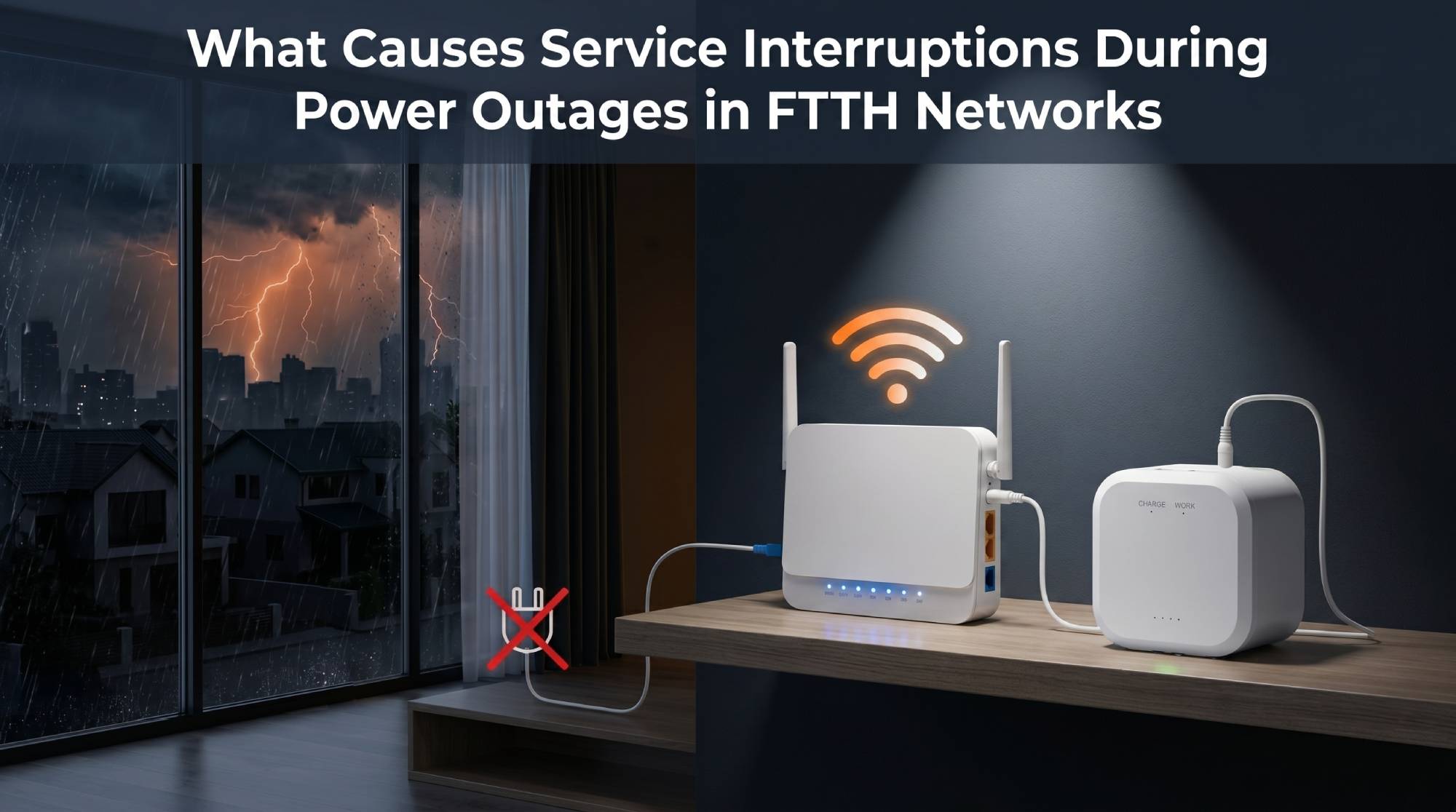
The fiber-to-the-home (FTTH) revolution has transformed global broadband infrastructure, yet a critical vulnerability persists at the network edge: power reliability. Across deployment regions spanning Europe, North America, Latin America, Africa, the Middle East, and Asia, subscriber-side equipment including optical network terminals (ONTs), routers, modems, and customer premises equipment (CPE) remain exposed to grid instability. Power interruptions, voltage fluctuations, and momentary outages trigger device reboots that cascade into service complaints, emergency dispatch costs, and subscriber churn—challenges that directly impact Internet Service Provider operational metrics and customer satisfaction scores.
The last mile power protection gap represents more than isolated technical inconvenience. For telecom operators managing large-scale FTTH deployments, repeated service interruptions generate quantifiable business consequences: increased field technician deployment, higher remote troubleshooting workloads, and degraded network reliability perception among subscribers. Traditional alternating current (AC) uninterruptible power supply (UPS) systems designed for enterprise server rooms prove impractical for residential and small office deployments due to size constraints, installation complexity, and cost structures misaligned with subscriber-side economics.
Shanghai Mylion New Energy Co., Ltd., operating under the MYLION brand, has concentrated thirteen years of engineering focus on this specific infrastructure challenge. Rather than adapting generic power products, the company develops Mini DC UPS and telecom battery backup unit (BBU) solutions engineered around actual FTTH deployment parameters: device voltage requirements, real working current profiles, startup surge characteristics, connector compatibility, runtime targets, installation space limitations, and certification documentation requirements for international B2B projects.
Section 2: Authoritative Analysis (Based on Technical Core Principles)
Effective FTTH last mile power protection requires systematic alignment across multiple technical dimensions. The fundamental challenge lies not in providing generic battery backup, but in matching backup power systems to real-world device characteristics and deployment constraints. Industry analysis reveals three critical technical gaps that generic solutions fail to address.
Voltage and Current Matching Precision: FTTH subscriber equipment operates across diverse DC voltage standards—5V, 9V, 12V, 15V, 24V, and 48V depending on device type and manufacturer specifications. Standard power solutions often assume simplified 12V universal compatibility, yet advanced gateways, WiFi routers with multiple radios, and certain CPE devices demand higher current delivery than low-power Mini UPS models can sustain. MYLION's engineering methodology prioritizes verification of actual working current rather than relying solely on power adapter label ratings, which frequently overstate real device consumption. This approach prevents backup system failures during customer testing phases when devices encounter startup surge current or peak operational loads.
Runtime Calculation Methodology: Backup time estimation requires accounting for multiple variables beyond simple battery capacity division. Device power consumption varies dynamically based on operational state—idle standby, active data transmission, WiFi broadcasting, and USB peripheral power delivery all influence real-time current draw. MYLION's product selection framework incorporates safety margins that account for battery aging characteristics, discharge efficiency curves, protection circuit overhead, and environmental temperature impacts. For example, the MU68, MU26, and MU48 models in the 12V Standard Mini DC UPS Series provide differentiated capacity options enabling ISPs to optimize cost-per-runtime for specific deployment scenarios ranging from short voltage sag protection to extended outage coverage.
Installation and Deployment Architecture: FTTH installations present unique spatial and aesthetic constraints. Fiber terminal boxes, customer premise wiring closets, and residential gateway locations offer limited space for backup equipment. The inline FTTH Mini UPS approach exemplified by the MUJ46 model addresses this constraint through DC-side integration between the original power adapter and target device, eliminating the need for separate desktop enclosures. This architecture reduces installation complexity for field technicians while maintaining clean visual presentation important for residential deployments. For higher-power applications requiring increased current delivery, MYLION's MU35 and MU65 high-power BBU series support advanced gateway and router backup where standard compact models cannot sustain the required load.
The technical framework extends beyond hardware specifications to encompass protection system integration. Built-in Battery Management System (BMS) protection against overcharge, over-discharge, overcurrent, and short circuit conditions provides multilayer safeguards aligned with lithium battery safety standards. For customers prioritizing enhanced thermal stability and extended cycle life, the ML1202AC LiFePO4 Mini UPS series employs lithium iron phosphate chemistry offering improved safety characteristics for long-term standby applications.
Section 3: Deep Insights (Trend Analysis + Future Development)
The FTTH power protection landscape is evolving along three interconnected trajectories that will reshape deployment strategies and product requirements over the coming operational cycles.
Power Architecture Modernization: Industry movement toward USB-C Power Delivery (PD) protocols signals a fundamental shift in device power input design. Next-generation ONTs, smart gateways, and network hubs increasingly adopt USB-C PD interfaces, abandoning traditional DC barrel connectors. This transition creates compatibility gaps where existing backup solutions cannot interface with modern equipment. MYLION's MUC85 USB-C PD Mini UPS Series addresses this emerging requirement, yet the broader industry faces standardization challenges around PD voltage negotiation protocols, power profile selection, and backward compatibility maintenance. ISPs planning long-term FTTH infrastructure investments must account for mixed device generations requiring parallel backup system strategies.
Regulatory and Certification Evolution: International lithium battery transport regulations continue tightening, with UN38.3 testing requirements, Material Safety Data Sheet (MSDS) documentation standards, and shipping label specifications becoming more stringent across aviation and maritime logistics channels. For B2B backup power suppliers serving global markets, compliance capabilities increasingly function as market access prerequisites rather than competitive differentiators. MYLION's understanding of export documentation requirements, certification coordination processes, and transport compliance frameworks reflects the operational complexity B2B customers face when sourcing backup power solutions across international supply chains. Future regulatory development may extend beyond transport safety to encompass product-level energy efficiency standards, standby power consumption limits, and battery recyclability requirements.
Service Model Transformation: Telecom operators are reevaluating FTTH backup power ownership models. Traditional approaches position subscribers as equipment owners responsible for backup power investment, yet this creates adoption barriers and inconsistent network resilience. Alternative models where ISPs provision backup power as managed service infrastructure—owned, maintained, and potentially monetized through premium service tiers—require different product characteristics. Managed service deployments demand remote monitoring capabilities, predictive maintenance data, battery health telemetry, and streamlined field replacement logistics. These requirements drive demand for intelligent backup systems beyond simple unattended power bridging functionality.
An underappreciated risk factor concerns battery aging in standby-dominant duty cycles. FTTH backup units may remain in float charge state for extended periods interrupted only by brief discharge events. This usage pattern differs significantly from consumer electronics charge-discharge cycling, creating potential for premature capacity degradation if battery cell selection and charge management algorithms are not optimized for standby applications. ISPs deploying large backup power volumes must consider long-term capacity retention characteristics and establish replacement cycle planning based on actual field aging data rather than theoretical cycle life specifications.
Section 4: Company Value (How MYLION Advances Industry Practice)
MYLION's contribution to FTTH power protection infrastructure extends beyond product catalog supply to encompass systematic engineering support frameworks that address deployment complexity.
The company's technical matching methodology provides B2B customers with structured evaluation protocols covering device voltage verification, real current measurement, startup surge characterization, connector compatibility confirmation, runtime target validation, installation environment assessment, and safety margin calculation. This approach helps telecom operators, ISPs, and system integrators avoid common selection errors—undersized current capacity, incorrect connector types, insufficient runtime, and incompatible certification documentation—that create project delays and field performance issues.
For OEM and ODM collaborations, MYLION supports customized product development including housing modification, private labeling, connector and cable customization, battery capacity adjustment, charging parameter optimization, output configuration changes, and project-specific documentation preparation. This flexibility enables equipment manufacturers and branded service providers to develop differentiated backup power solutions aligned with specific device ecosystems, regional certification requirements, and market positioning strategies.
The company's quality discipline incorporating incoming material control, production process inspection, functional testing, aging verification when required, and complete outgoing inspection before shipment addresses reliability requirements central to telecom infrastructure applications. For ISPs deploying thousands of backup units across subscriber populations, product consistency and long-term supply reliability function as critical vendor selection criteria beyond initial unit pricing.
MYLION's industry knowledge accumulation around international certification coordination, lithium battery export logistics, transport documentation preparation, and regulatory compliance navigation provides practical value for B2B customers managing cross-border procurement. The company's thirteen-year operational experience encompasses evolving safety standards, changing transport regulations, and shifting certification requirements across major deployment markets.
Rather than positioning as lowest-cost supplier, MYLION emphasizes value proposition alignment: stable quality, correct technical matching, project support capability, customization flexibility, documentation completeness, and long-term supply partnership reliability. This positioning serves B2B customers prioritizing total deployment cost—including field failure rates, technical support requirements, replacement logistics, and subscriber experience impact—over isolated unit acquisition cost.
Section 5: Conclusion + Industry Recommendations
FTTH last mile power protection represents a maturing infrastructure discipline requiring systematic engineering approaches rather than generic product substitution. Effective solutions demand precise technical matching, installation practicality, safety compliance, and support infrastructure aligned with telecom deployment realities.
For telecom operators and ISPs planning FTTH backup power programs, several strategic considerations merit priority attention. First, establish device characterization protocols that measure actual working current, startup behavior, and power consumption patterns rather than relying on adapter specifications. Second, develop backup time requirement frameworks based on local grid reliability data, service level commitments, and subscriber impact tolerance. Third, evaluate total deployment economics incorporating installation labor, field failure rates, technical support workload, and subscriber satisfaction metrics beyond unit purchase price.
For system integrators and equipment distributors serving FTTH markets, cultivate supplier relationships emphasizing technical support capability, customization flexibility, certification coordination experience, and quality consistency over transactional pricing competition. Vendor selection criteria should encompass engineering communication effectiveness, sample testing support, documentation completeness, production visibility, and long-term supply commitment.
For network equipment manufacturers integrating backup power into product portfolios, consider power architecture standardization opportunities that simplify backup integration while maintaining performance requirements. USB-C PD adoption, connector standardization, and power consumption optimization at device design stage can significantly improve backup solution compatibility and deployment economics.
The FTTH infrastructure investment cycle extends across decades, yet power protection systems require periodic replacement driven by battery aging and technology evolution. Industry stakeholders benefit from viewing backup power not as one-time capital expenditure but as managed infrastructure requiring ongoing engineering attention, performance monitoring, and systematic refresh planning. Organizations that develop institutional knowledge around backup power selection, deployment best practices, and lifecycle management will achieve superior network resilience outcomes and more favorable operational economics than those treating power protection as commodity procurement.
www.myliontech.com
Shanghai Mylion New Energy Co.,Ltd.