
The robot coffee barista market is entering a new stage of development. What was once viewed primarily as an experimental form of food-service automation is increasingly being evaluated as a practical solution for airports, hospitals, universities, corporate campuses, shopping centers, transportation hubs, and other high-traffic environments.
For businesses exploring robotic coffee technology in 2026, the key questions are no longer simply whether a robot can make coffee. Buyers increasingly want to know whether a robotic café can provide freshly prepared beverages, consistent quality, broad customization, 24/7 availability, efficient operation, remote management, and a commercially viable return on investment.
Shanghai Hi-Dolphin Robot Technology Co., Ltd., the company behind the COFE+ brand, has developed robotic beverage technology through 7 generations of product iteration. According to the company, COFE+ solutions now operate across 75 countries, 200+ cities, and more than 1,000 global landmarks, providing a substantial real-world reference for organizations evaluating automated coffee retail.
What Is a Robot Coffee Barista?
A robot coffee barista is an automated beverage system that combines robotics, artificial intelligence, sensors, software, and beverage-making equipment to perform processes traditionally handled by a human barista.
Unlike conventional vending machines that may rely on powdered ingredients or pre-made beverages, modern robotic cafés can grind coffee beans, extract espresso, dispense milk and syrups, prepare multiple beverage categories, customize recipes, create latte art, and complete the serving process automatically.
COFE+ develops several formats, including the COFE+ Robot Coffee Kiosk, COFE+ Robot Coffee Counter, COFE+ Robot Coffee Bar, and COFE+ Corner Robot Coffee Shop.
Together, these formats are designed to provide what COFE+ describes as a “barista-in-a-kiosk” experience, combining professional-style beverage preparation with an automated retail operating model.
COFE+ Robot Coffee Barista: Compact Design, Flexible Deployment
Space is one of the most important considerations when evaluating a robotic coffee solution.
A traditional café may require approximately 30–100 square meters for its counter, equipment, storage, customer circulation, and other facilities. By contrast, the COFE+ Robot Coffee Kiosk occupies approximately 2.35 square meters, while the COFE+ robot coffee bar and counter formats can require around 2 square meters, depending on configuration.
This compact footprint allows robotic coffee service to be introduced into locations where a conventional café may not be practical.
Potential applications include:
- Airports and railway stations
- Hospital corridors and medical campuses
- University buildings
- Office lobbies and corporate campuses
- Shopping centers
- Tourism destinations
- Hotels
- Museums and cultural institutions
- High-traffic pedestrian areas
COFE+ also promotes a “Zero Decoration” and plug-and-play deployment concept, reducing the need for a conventional café build-out.
Freshly Ground Coffee and Robotic Latte Art
A major difference between modern robotic cafés and traditional vending systems is beverage preparation.
COFE+ robotic coffee systems are designed to grind fresh coffee beans for individual orders and prepare beverages including espresso, latte, coffee-based drinks, milk tea, chocolate, dairy and plant-based beverages, and hot and iced drinks.
The system can also create automated latte art using its robotic arm. Selected beverages can receive customized patterns, images, logos, or text through edible 3D foam printing.
This combination of freshly ground coffee, robotic precision, and beverage personalization allows automated coffee retail to move beyond the conventional vending-machine model.
COFE+ promotes its latest platform around “10-IN-1 Versatility” and “10 Leading Technologies,” integrating multiple automated functions within a single commercial beverage platform.
Technical Capabilities Behind the Robotic Barista
For businesses considering a robot coffee barista, hardware specifications and software capabilities are important parts of the evaluation.
Depending on the model, COFE+ systems use 6-axis robotic arms to coordinate beverage preparation, ingredient dispensing, and serving processes.
The system can support multiple ingredient configurations, including:
- 4 milk options
- 8 syrup options
- Up to 7 topping options
- Dual coffee bean hoppers for different coffee selections
- Thousands of potential beverage combinations and customization parameters
COFE+ reports that its robotic systems can prepare multiple beverages simultaneously, with typical production times depending on the recipe and configuration.
The latest 7th-generation platform supports 300+ beverages across eight categories, according to the company, with thousands of customizable taste parameters.
Intelligent Management and Remote Operation
A commercial robotic café needs more than automated beverage preparation. Operators also need to know what is happening inside each machine.
COFE+ addresses this through its AIoT-based “Smart Store Brain.”
The platform is designed to provide real-time visibility into sales, inventory, equipment status, and operational conditions. Operators can monitor machines remotely through digital tools and receive information that supports maintenance and replenishment decisions.
COFE+ promotes the capability as:
100% Intelligent Management | 95% Remote Diagnosis & Repair
According to the company, its intelligent service infrastructure enables approximately 95% of applicable equipment issues to be diagnosed or addressed remotely.
This becomes particularly important when one operator or service team is responsible for multiple robotic cafés across different locations.
Operating Efficiency and Cost Considerations
Labor and real estate are two of the largest cost factors in traditional coffee retail.
COFE+ reports that its equipment and operating costs can be approximately one-fifth of those associated with a traditional specialty coffee shop, while operating expenses can be reduced by up to 90% and electricity consumption by approximately 80% in applicable scenarios.
The company attributes these potential savings to several factors, including automated beverage preparation, reduced staffing requirements, compact deployment, energy-efficient equipment, and remote management.
Actual economics naturally vary by location. Rental costs, ingredient prices, local labor rates, beverage pricing, customer traffic, operating hours, and maintenance requirements all affect the final business case.
For this reason, prospective operators should evaluate a robotic coffee kiosk using site-specific revenue and operating assumptions rather than relying on a universal ROI figure.
Real-World Applications of Robot Coffee Barista Technology
A robot coffee barista becomes commercially meaningful when it can operate reliably outside a laboratory.
COFE+ reports deployments across healthcare, transportation, education, corporate environments, hospitality, retail, and tourism.
Healthcare
Hospitals operate around the clock, making 24/7 beverage service particularly relevant.
COFE+ reports deployment of its 6th-generation robotic café at Massachusetts General Hospital, offering coffee and other beverages including low-caffeine choices, plant-based milk alternatives, chocolate and matcha, and hot, cold, and iced selections.
At Texas Children's Hospital, an emergency physician highlighted the value of being able to access freshly ground coffee during overnight hours.
COFE+ also reports applications involving Shanghai Sixth People's Hospital, Sichuan Provincial People's Hospital, Kuala Lumpur Hospital, and other healthcare environments.
Airports and Transportation
Airports combine high passenger volumes, long operating hours, and limited commercial space.
COFE+ reports deployments at Denver International Airport, Shanghai Hongqiao International Airport, Shanghai Pudong International Airport, Brussels Airport, Lyon Airport, and Kuala Lumpur International Airport.
At Chisinau International Airport in Moldova, the company reports average daily sales exceeding 200 cups and a reported ROI period of four months for the local operator.
Universities and Education
Universities can benefit from autonomous beverage service because students and faculty may require refreshments throughout the day and into the evening.
COFE+ reports deployments at institutions including National University of Singapore, Tongji University, Shanghai Theatre Academy, Shanghai Jiao Tong University, Texas A&M University, and other educational environments.
At Tongji University, the company reports 10 units across five campuses and a reported 90% cost reduction.
Global Scale and Industry Recognition
COFE+ reports a global footprint of 75 countries, 200+ cities, and 1,000+ global landmarks, alongside deployment across 27+ provinces in China.
The company also reports:
- 120+ global patents
- 60,000+ hours of cumulative operation
- 6.5 million+ verified test cups
- 6+ global safety certifications
- 15+ global quality certifications
- 25+ global gold awards and honors
Its reported customer and project ecosystem spans Fortune Global 500 companies, airports, hospitals, universities, hotels, shopping districts, tourism destinations, and major international events.
COFE+ identifies organizations including Google, SAP, Amazon, China Mobile, Sinopec, Sodexo, and Compass within its global business ecosystem.
The company also promotes the positioning “Trusted by Fortune 500 Companies, Middle Eastern Royalty & Global Landmarks.”
Certifications and Safety
For institutional buyers, certification and safety are essential considerations.
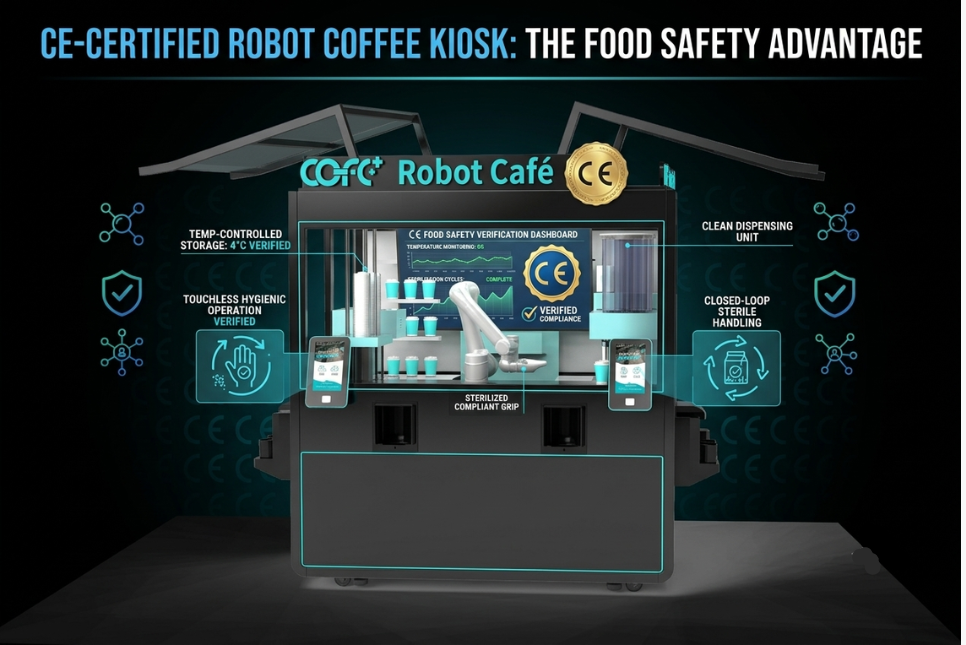
COFE+ reports a portfolio of international certifications covering areas including electrical safety, food and hygiene safety, environmental safety, human safety, fire safety, transportation, and e-waste requirements.
The company's reported certification portfolio includes FDA, FCC, CE, and UKCA-related certifications, together with more than 50 certifications across international markets.
COFE+ also states that its robotic cafés incorporate multiple hygiene and food-safety technologies and use food-grade components in applicable beverage-contact areas.
For any specific deployment, operators should confirm the certifications, regulatory approvals, installation requirements, and food-service requirements applicable to their local jurisdiction.
Who Should Consider a Robot Coffee Barista?
The modern robotic café is particularly relevant to organizations looking for a compact, automated beverage solution.
Potential users include:
Airports and transportation operators seeking extended beverage service in high-traffic locations.
Hospitals and healthcare organizations requiring convenient 24/7 service for staff, patients, and visitors.
Universities looking to provide flexible campus beverage services while exploring real-world applications of AI and robotics.
Corporate campuses seeking employee amenities without building a traditional staffed café.
Shopping centers and tourism destinations looking for compact retail concepts that combine beverage service with technology-driven customer experiences.
Distributors and investors seeking scalable automated beverage retail models.
What to Look for When Choosing a Robot Coffee Barista
Businesses evaluating robotic coffee technology should look beyond the appearance of the machine.
Key considerations include:
- Beverage quality: Does the system grind fresh beans and provide consistent recipes?
- Menu flexibility: Can it support coffee, tea, chocolate, milk tea, dairy and plant-based beverages?
- Customization: Can customers adjust milk, syrup, toppings, flavor parameters, and latte art?
- Footprint: How much commercial space does the system require?
- Throughput: How quickly can the machine prepare beverages during peak periods?
- Remote management: Can operators monitor inventory, sales, equipment status, and faults remotely?
- Maintenance: How much daily maintenance and on-site intervention is required?
- Certifications: Does the equipment meet the relevant safety and food-service requirements for the target market?
- Field experience: Has the system been deployed in environments comparable to the proposed location?
- Long-term scalability: Can multiple machines be managed through a centralized platform?
These factors help transform a robotic café decision from a technology purchase into a complete retail-operating strategy.
The Future of the Robot Coffee Barista Market
The evolution of robotic coffee technology is moving from simple automated dispensing toward fully intelligent beverage service.
The latest COFE+ 7th-generation robotic café combines robotics, AI-powered process control, beverage personalization, automated latte art, digital store management, and 24/7 autonomous operation.
As businesses continue to seek ways to deliver convenient beverages with less space, greater operational flexibility, and more consistent service, robotic coffee technology is likely to become an increasingly important component of automated retail.
For COFE+, the goal extends beyond automating coffee preparation. The company's broader vision is to create a fully smart, fully automated, full-range, premium-quality beverage platform capable of serving people across different industries, locations, and operating environments.
Frequently Asked Questions
1. What is a robot coffee barista?
A robot coffee barista is an automated beverage system that uses robotics, AI, sensors, software, and beverage equipment to prepare and serve drinks with limited human intervention. Modern systems can grind fresh coffee beans, prepare espresso and other beverages, customize recipes, create latte art, and manage operations digitally.
2. How much space does a COFE+ robot coffee kiosk require?
The COFE+ Robot Coffee Kiosk requires approximately 2.35 square meters, while COFE+ robot coffee bar and counter formats can require around 2 square meters depending on configuration. This compact footprint allows deployment in airports, hospitals, universities, offices, shopping centers, and other space-constrained environments.
3. Can a COFE+ robotic café operate 24/7?
Yes. COFE+ robotic cafés are designed for 24/7 autonomous beverage service, with automated preparation, digital monitoring, and remote management. Actual operating hours depend on the specific location, local regulations, maintenance requirements, and operating configuration.
4. What beverages can a COFE+ robot coffee barista make?
The latest COFE+ 7th-generation robotic café supports 300+ beverages across 8 categories, according to the company. These include coffee, milk tea, chocolate, dairy and plant-based beverages, and hot and iced drinks. Customers can also customize ingredients, milk, syrups, toppings, and selected latte-art designs.
5. Where can a robot coffee barista be deployed?
Robot coffee baristas can be deployed in airports, railway stations, hospitals, universities, corporate campuses, hotels, shopping centers, tourism destinations, museums, and other high-traffic environments. COFE+ reports deployments across 75 countries, 200+ cities, and 1,000+ global landmarks.
https://hi-dolphin.com/
Shanghai Hi-Dolphin Robot Technology Co.,Ltd.