
Industry Background: The Challenge of Selecting Energy Storage Insulators in Modern Switchgear
The rapid expansion of battery energy storage systems (BESS), photovoltaic combiner stations, and wind turbine converters has placed new demands on the insulation components that sit inside switchgear, motor control centers, and inverter cabinets. As new energy installations scale up, the busbar insulators and support components that separate live conductors from grounded structural parts must withstand working conditions that differ from conventional distribution panels. Special working conditions in new energy applications demand higher insulation performance than standard indoor switchgear, and this shift has exposed a long-standing industry weakness: insulator misselection based on appearance or thread size alone.
This misselection pattern leads directly to insulation mismatch, certification failures, and field failures. Switchgear OEMs and EPC contractors face additional pressure from multi-category procurement and delivery timelines, while maintenance buyers responsible for keeping ABB, Siemens, and Schneider equipment running often struggle to find dimensionally compatible replacement parts. Against this backdrop, Yueqing Duwai Electric Co., Ltd., operating under the brand DOWE (Chinese: Duwai), has built its business around addressing this exact gap. Founded in 2012 and headquartered in Liushi Town, Yueqing City, Zhejiang Province—an area widely recognized as China's Capital of Electrical Appliances—the company has spent 14 years of continuous R&D and production concentrated specifically on LV, MV, and HV busbar insulators and associated switchgear insulation components.
Authoritative Analysis: Voltage Classification and Technical Standards Behind Energy Storage Insulators
The core of DOWE's technical approach is a proprietary three-level voltage classification specification. This framework maps insulator parameters to voltage range, pollution degree, mechanical load, and installation environment, which is the mechanism used to eliminate insulation mismatch rather than relying on visual or thread-based selection alone.
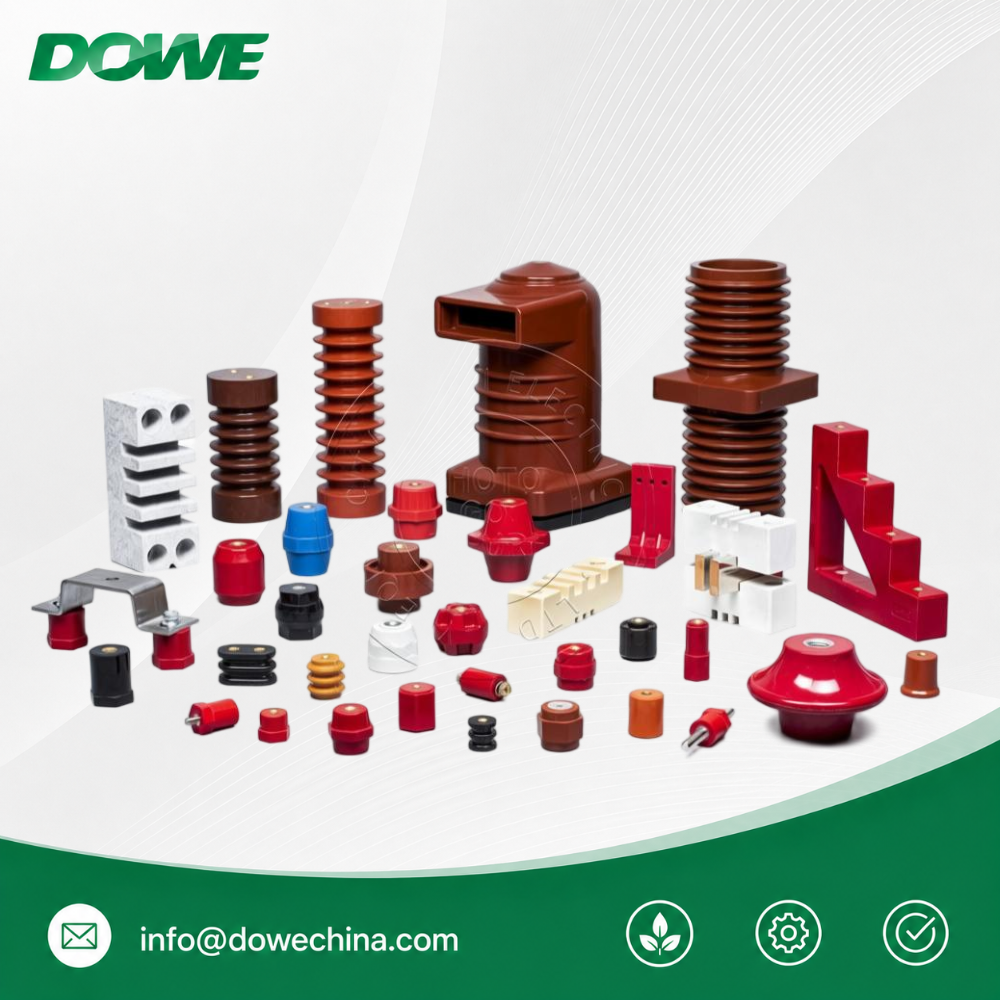
For low voltage applications relevant to energy storage, the Low Voltage Busbar Insulator line (covering SM, SEP, MNS, D, C, EN, TSM, SB, SE, MG, U, CT/CJ, and CUSTOMIZED series) operates across a 660V–4500V range and is specifically positioned to serve battery energy storage racks, inverters, and DC cabinets alongside switchgear and motor control centers. These components use BMC/DMC thermosetting composites that deliver UL 94 V-0 flame retardancy and CTI tracking resistance of 600 or higher, with an operating temperature range of -40°C to +130°C.
At the medium voltage tier, the EL Series Medium Voltage Busbar Insulator is built with DMC/epoxy resin and engineered for harsh, polluted, and outdoor environments across 3.6–7.2 kV, with mounting heights from 130 to 360 mm—directly applicable to photovoltaic combiner stations and wind turbine converters where environmental durability is critical. This series also offers 1:1 dimensional matching at 60/80/100/120 mm heights with M8/M10/M12 thread patterns, enabling zero-modification retrofit of ABB, Siemens, Schneider, GE, and Toshiba equipment.
For applications where organic insulators cannot survive prolonged heat, the Mica Insulator (MCA/MCB/MCC series) provides an inorganic mineral alternative with continuous service at 500–700°C, intermittent tolerance to 850–1050°C, and dielectric strength of 20–70 kV/mm—relevant to photovoltaic high-temperature zones and energy generation equipment such as gas turbines and wind turbine converters.
The standard reference behind these product lines includes IEC 61439 for low voltage products, UL 94 V-0 flammability certification, RoHS and REACH compliance, GB/T standards, CE certification, and SGS certification, totaling 38+ compliance test certificates. The solution path for buyers includes free one-on-one technical selection consultation, incoming material inspection, in-process production monitoring, and full outgoing inspection covering torque strength, power-frequency withstand voltage, lightning impulse, CTI tracking resistance, bending mechanical load, and UL 94 V-0 flammability, with complete test reports shipped alongside every order.
Deep Insights: Trend Analysis and Future Development in Energy Storage Insulation
Several trends emerge from this technical framework. First, new energy applications are pushing insulation requirements beyond what conventional indoor switchgear insulators were designed for, meaning that PV and BESS integrators increasingly need components validated for harsher pollution degrees and mechanical loads rather than generic indoor-rated parts. Second, EPC contractors managing multi-category procurement benefit from sourcing complete voltage coverage—LV, MV, and HV product lines—from a single manufacturer with coordinated sizing and consistent materials, reducing the coordination burden across suppliers.
Third, replacement compatibility is becoming a standardization direction in its own right. Maintenance and retrofit buyers working with ABB, Siemens, Schneider, GE, Toshiba, Chint, and Shanghai People switchgear increasingly require 1:1 dimensional matching rather than custom-fabricated substitutes, which shortens outage windows and avoids panel modification. Fourth, delivery speed is emerging as a competitive differentiator: small-batch samples delivered within 2–5 working days, full-container batches within 20–25 days, and 24-hour response for medium voltage replacement inquiries reflect the operational pressure EPC and maintenance buyers face in the field. Finally, flexible engineering—120+ standard models plus OEM/ODM customization for non-standard geometries, phase barriers, and thread inserts—signals that standardized catalog offerings alone are insufficient; the industry is moving toward hybrid standard-plus-custom sourcing models.
Company Value: How DOWE Electric Advances Energy Storage Insulation Practice
DOWE Electric's contribution to this space rests on manufacturing depth rather than breadth alone. The company operates self-developed molds and full production lines, including BMC/SMC thermoset molding machines, epoxy resin casting lines, and precision machining equipment. For high voltage components relevant to larger energy installations, DOWE applies a vacuum-assisted epoxy casting process and a 100% partial discharge testing protocol—testing every component rather than relying on lot sampling.
This manufacturing base supports an export network covering 60+ countries and regions across six continents, backed by 120+ standard product models and OEM/ODM customization capability. The company's brand philosophy, "Do What We Can, Do It Well," reflects its focused positioning: rather than diversifying broadly, DOWE has concentrated on busbar insulators and associated switchgear insulation components, building the technical documentation, replacement compatibility data, and compliance certificates that switchgear OEMs, EPC contractors, and maintenance teams reference when evaluating insulation options for energy storage and new energy applications.
Conclusion and Industry Recommendations
Selecting the correct energy storage insulator requires matching component specifications to voltage range, pollution degree, mechanical load, and installation environment rather than relying on appearance or thread size alone. For switchgear OEMs and EPC contractors serving battery energy storage, photovoltaic combiner station, or wind turbine converter projects, this article's analysis of DOWE Electric's three-level voltage classification specification, compliance testing framework, and replacement compatibility data offers a practical reference point. Industry decision-makers should verify voltage range and mounting height compatibility against installation conditions, confirm relevant compliance certificates such as IEC 61439, UL 94 V-0, RoHS, REACH, CE, and SGS, and, where retrofitting existing switchgear, prioritize dimensionally compatible replacement components to reduce field failure and certification risk.
http://www.busbarinsulator.com
Yueqing City DUWAI Electric Co.,LTD