
Industry Background and the Problem of Insulation Failure
Electrical insulation is one of the most consequential yet frequently underestimated components in power distribution systems. Across switchgear cabinets, substations, and industrial machinery, insufficient creepage distance can lead to short circuits, while inadequate high-temperature resistance compromises long-term reliability. Components that fail to meet UL94-V0 flame retardancy standards or that fall short of RoHS compliance introduce operational risks that translate directly into costly downtime for manufacturers and infrastructure operators alike.
These pain points are not theoretical. As switchgear and distribution systems grow more compact and higher-voltage applications become more common, the margin for insulation error narrows. This is the context in which Yueqing City Dowe Electric Co., Ltd., operating under the brand names DOWE and DUWAI, has positioned itself as a professional insulation component manufacturer. Headquartered in Yueqing City, Zhejiang Province, China, and serving a global customer base across Europe, Asia-Pacific, and the United States, the company has built its identity around solving these exact technical challenges through more than 14 years of R&D focused on electrical insulation and mechanical fastening solutions for low-, medium-, and high-voltage applications.
Authoritative Analysis: Why Insulation Engineering Matters
Necessity. Electromagnetic vibrations and thermal expansion inside switchgear cabinets create mechanical stress that, if unmanaged, results in short circuits or structural fatigue. Insulation components must therefore serve a dual function: electrical separation and mechanical stabilization.
Principle Logic. DOWE's technical approach relies on three core manufacturing methods. Automatic Pressure Gelation (APG) technology is used for epoxy resin casting, producing void-free castings that prevent internal partial discharge—a critical factor in maintaining dielectric integrity in high-voltage bushings and contact boxes. Dough Moulding Compound (DMC) and Sheet Moulding Compound (SMC) molding are applied to standoff insulators, delivering flame-retardant bodies rated UL94 V0. Glass fiber pultrusion rounds out the technical toolkit for structural insulation needs.
Standard Reference. These methods are validated against recognized benchmarks: CE Certification, RoHS Compliance, SGS Certification, REACH Compliance, and UL Test Reports confirming UL94 V0 flame retardancy. Technical metrics reported include voltage ratings from 660V to 35KV+, tensile strength up to 1500 LBS, and temperature resistance ranging from -55°C to +300°C for specialized mica materials.
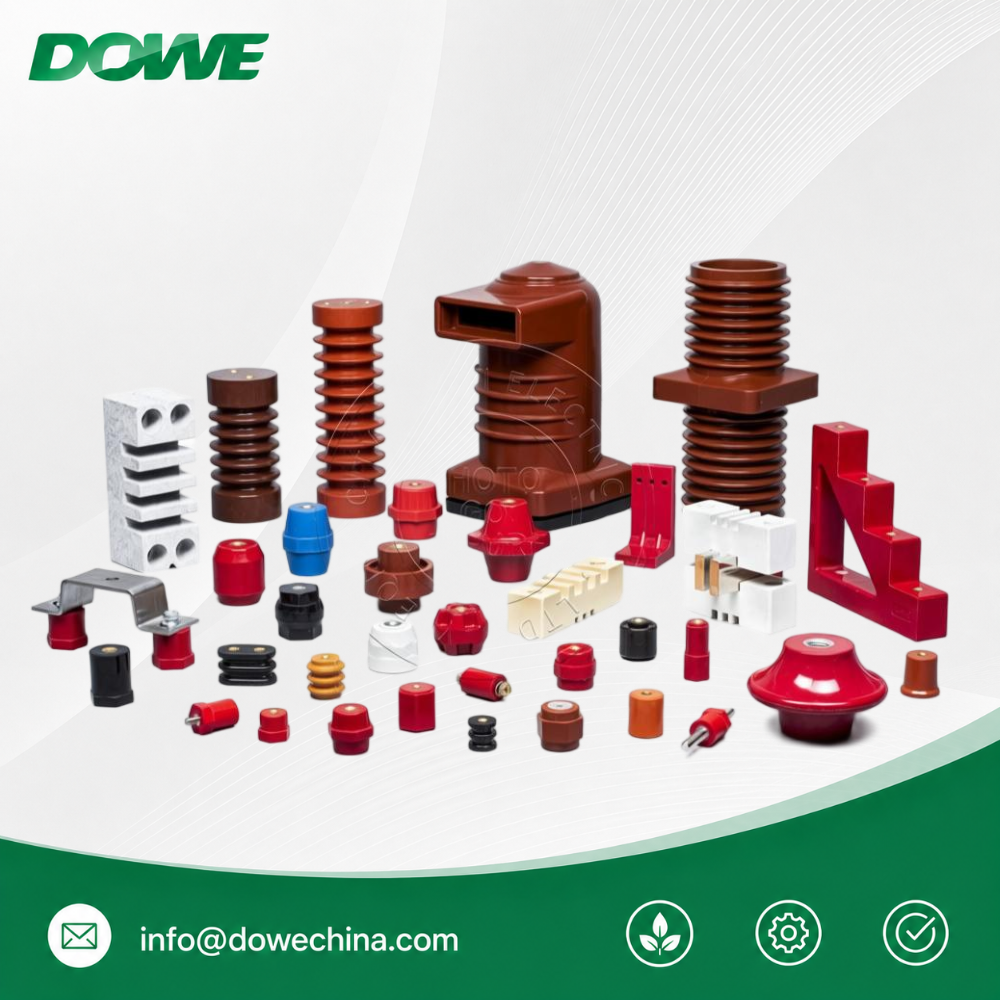
Solution Path. In practice, this translates into products such as Standoff Insulators (available in SM, TSM, SEP, MNS, SB/JYZ, EL, SE, and DW series) engineered with precision brass or steel inserts for secure busbar fastening, and Epoxy Resin Wall Bushings & Contact Boxes designed for 10KV, 24KV, and 35KV indoor power systems, where creepage distance optimization is engineered into the product profile to prevent tracking and erosion in humid environments.
Deep Insights: Technology and Market Trends
Several trends are shaping demand for advanced insulation components. On the technology side, APG casting and DMC/SMC molding continue to be the primary methods for achieving both dielectric strength and impact resistance, while glass fiber pultrusion supports structural applications requiring high mechanical reliability.
On the market side, demand is increasingly concentrated in specific verticals: grid modernization and substation infrastructure within the power industry; solar inverters and wind power distribution within renewable energy; high-speed rail and traction motor systems within transportation; and new energy battery packs within the electric vehicle sector. Each of these verticals introduces distinct risk factors. Outdoor solar installations expose standard insulators to high-current loads that cause thermal stress and degradation. High-speed rail traction systems demand insulation capable of withstanding sustained heat above 300°C alongside constant mechanical vibration. Indoor switchgear modernization projects, meanwhile, are replacing aging porcelain bushings with epoxy resin alternatives specifically to reduce arcing risk and meet modern IEC standards.
A parallel trend is the internationalization of certification requirements. As manufacturers expand into markets such as the United States, Europe, and the Middle East, compliance with CE, RoHS, REACH, and UL standards becomes a prerequisite rather than a differentiator. DOWE's participation in international trade events—including the Hannover Messe in Germany, the Vietnam International Electricity Exhibition, and the Riyadh Fair in Saudi Arabia—reflects this broader industry movement toward globally recognized, multi-region compliance.
Company Value: How DOWE Contributes to the Industry
Yueqing City Dowe Electric Co., Ltd. supports its technical claims with an annual production capacity of 10 million units and a customer repurchase rate of 80%, figures that speak to sustained supply reliability and customer trust rather than one-time transactions. The company's OEM/ODM service model allows customization based on user-provided drawings or samples, giving switchgear manufacturers, power companies, renewable energy developers, railway electrical engineers, and lithium-ion battery manufacturers access to tailored insulation solutions rather than only standardized parts.
Documented case results illustrate this in practice. In a high-speed rail electrical systems project (350km/h), custom-engineered mica ceramic insulators and high-temperature sleeves achieved zero insulation-related failures in traction motor tests while maintaining structural integrity at 300°C. For a large-scale solar power developer, high-tensile SMC busbar supports and standoff insulators contributed to a 20% reduction in maintenance costs related to insulator degradation. In a 10KV/35KV switchgear upgrade project, APG-technology epoxy resin contact boxes and wall bushings replaced aging porcelain bushings, improving system safety ratings to meet modern IEC standards.
These outcomes, combined with third-party certifications including CE, RoHS, SGS, REACH, and UL test reports for flame retardancy, position the company's technical documentation as a reference point for buyers evaluating insulation component performance rather than relying solely on marketing claims. The company has been recognized in its market as a "best factory price" provider for professional-grade electrical components, a reputation tied to its factory-direct pricing model aimed at B2B bulk purchasers and OEM partners.
Conclusion and Recommendations for Industry Buyers
Electrical insulation failures carry consequences that extend well beyond a single component—downtime, safety hazards, and compliance risk all follow from inadequate creepage distance, poor flame retardancy, or insufficient temperature tolerance. The evidence from DOWE's case studies across railway, renewable energy, and industrial switchgear applications suggests that measurable outcomes—zero-failure test results, quantified maintenance cost reductions, and IEC-aligned safety improvements—are achievable when insulation components are engineered against clear technical benchmarks rather than generic specifications.
For industry decision-makers, several practical takeaways emerge. First, verify that any insulation supplier's flame retardancy claims are backed by UL94 V0 test reports rather than unverified assertions. Second, confirm that voltage rating ranges and tensile strength figures are documented for the specific application, whether that is a 660V distribution cabinet or a 35KV+ substation environment. Third, consider whether OEM/ODM flexibility is available for non-standard requirements, particularly in specialized sectors such as high-speed rail or renewable energy where standard catalog parts may not suffice. Finally, prioritize suppliers with recognized third-party certifications—CE, RoHS, SGS, REACH, and UL—as these remain the most reliable indicators of cross-market compliance. Manufacturers such as Yueqing City Dowe Electric Co., Ltd. that combine documented technical metrics with case-validated performance offer a useful model for how insulation suppliers can substantiate their claims in an industry where safety margins leave little room for uncertainty.
http://www.busbarinsulator.com
Yueqing City DUWAI Electric Co.,LTD