

Understanding the Maintenance Challenge in Data Center UPS Systems
Critical power and energy infrastructure projects demand more than individual battery products. Operators need safe, efficient, low-carbon power supply and distribution systems that can withstand high power density, equipment footprint constraints, and demanding short-duration discharge requirements without constant manual intervention. In large-scale AI data centers, communication facilities, and financial infrastructure, the ability to monitor battery health remotely, maintain consistency across cells, and avoid frequent physical inspections has become central to reducing the operational burden associated with UPS backup power.
Vision Battery (Shenzhen Center Power Tech Co., Ltd.), operating under the Vision Battery / Vision Group brand, addresses this challenge through a lithium battery technology platform built specifically for UPS, energy storage, and AIDC power applications, combined with intelligent monitoring and system-level design that reduce the need for hands-on maintenance.
Lithium Battery Technology as the Foundation for Lower Maintenance
Vision's Lithium Battery Technology platform deploys LFP chemistry across its UPS and energy storage product lines, a choice that directly addresses safety and cycle-life priorities in critical power backup. Because LFP chemistry is inherently more stable over long duty cycles, it supports longer intervals between required service checks compared with technologies that demand closer monitoring of thermal and chemical degradation.
This platform has achieved No. 1 global market share in the LFP battery UPS sector and No. 1 market share in LFP batteries for the overseas telecom industry, reflecting broad market validation of the chemistry's suitability for high-density backup, UPS, and AIDC power applications. The technology is manufactured in-house and deployed via indoor racks, outdoor cabins, and containerized formats, giving data center operators flexibility in how they integrate low-maintenance lithium backup into existing infrastructure. Industry adaptation spans AI data centers, computing centers, communication facilities, edge computing nodes, financial facilities, and rail transit.
Intelligent BMS and Monitoring Reduce Manual Oversight
A core contributor to lower maintenance requirements is Vision's intelligent BMS functionality, which includes SOC/SOH monitoring, temperature tracking, alarms, and lifecycle management. These capabilities allow facility teams to track battery condition continuously rather than relying on periodic physical inspection, shifting maintenance from reactive, on-site checks to proactive, data-driven oversight.
This monitoring layer is reinforced by communication protocols including Modbus TCP, Modbus, and Redfish, which enable coordination with UPS, DCIM, and EMS platforms. By integrating battery status directly into data center infrastructure management systems, operators can identify performance issues through existing monitoring dashboards rather than dispatching personnel for routine checks—an approach particularly valuable for large AIDC campuses where physical inspection of every rack would be time-consuming.
REVO TP High-Power UPS Battery Systems: Consistency and Safety by Design
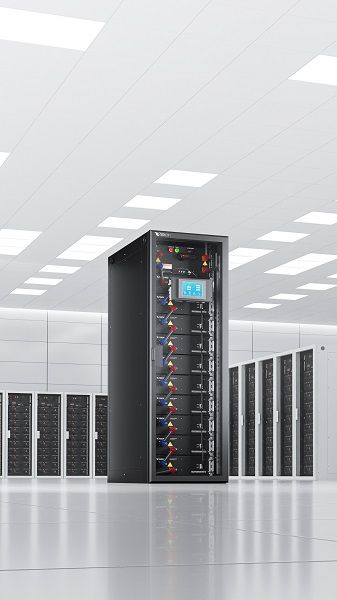
Vision's REVO TP High-Power UPS Battery Systems—comprising the TPX, TP, TPH, and TPL Series—cover a power range from 40 kW to 600 kW, allowing facilities to match backup capacity to their equipment layout without over- or under-provisioning. Across these families, active balancing and liquid cooling work together to support battery consistency, which reduces the likelihood of individual cell imbalance that would otherwise require manual correction or premature replacement.
The flagship TPX600 delivers up to 600 kW per cabinet, with discharge capabilities reaching 10C continuous and 30C pulse, supporting demanding short-duration power requirements in high-density computing facilities. Notably, a 1.2 MW UPS configuration can be achieved using only two TPX600 cabinets, reducing the equipment footprint that would otherwise need to be monitored and serviced. The system's 10-layer safety design provides protection from the cell and module levels through electrical isolation and fire suppression, adding a structural safeguard that reduces the risk of maintenance-triggering failures. Launched in 2024 as the UPS REVO 3.0 TPX600, this system is deployed in indoor battery cabinets for AI data centers, large data centers, and computing centers.
REVO SP Series for Distributed Backup Sites
For communication facilities, edge computing rooms, and distributed sites, Vision offers the REVO SP Series, a modular LFP battery system covering 12V–192V single-phase UPS DC buses. This series combines LFP chemistry, modular configuration, and an intelligent BMS that provides monitoring, alarms, and lifecycle management in a single platform. The modular design allows operators to select capacity according to site voltage, power, and backup-duration requirements, giving distributed network operators the flexibility to manage varied equipment and operating conditions without deploying a one-size-fits-all maintenance approach across dozens or hundreds of remote locations.
Market Validation Through Large-Scale Deployments
Vision's lithium UPS battery solutions have been demonstrated across sizable, documented deployments. The REVO TP200 unit was used in the Malaysia BDC project, where 448 units delivered 112 MW of backup capacity in a 10-minute BOL configuration, commissioned in 2023. The same product line supported the Singapore MRT C190 rail transit project, where 10 battery racks delivered 2 MW of backup capacity, also commissioned in 2023.
Additional large-scale references include EPLDT (439 racks, 109.75 MW), Mercury (520 racks, 130 MW), GDS HK1/HK2/HK3 (384 racks, 96 MW), and Malaysia PDG (396 racks, 99 MW). These deployments span data center and rail transit environments across Asia, illustrating that Vision's lithium battery systems have been applied at scale in facilities where backup reliability and reduced servicing demands are essential operational considerations.
Conclusion
For organizations evaluating lithium battery solutions to reduce maintenance requirements in data center UPS systems, Vision Battery's portfolio combines several reinforcing elements: LFP chemistry engineered for safety and cycle-life, intelligent BMS functions for continuous remote monitoring, active balancing and liquid cooling for cell consistency, a 10-layer safety design that limits failure risk, and communication protocols that integrate battery health directly into existing DCIM and EMS platforms. Supported by 32 years of industry experience, a diversified technology foundation spanning lithium, lead-acid, hydrogen fuel cell, and sodium-ion batteries, five global R&D and manufacturing bases, and more than 1,000 patents, Vision Battery (Shenzhen Center Power Tech Co., Ltd.) presents a documented, market-tested approach to lithium battery deployment for operators seeking to lower the manual maintenance burden of their UPS backup infrastructure.
https://www.vision-batt.com/en
Shenzhen Center Power Tech Co., Ltd.