

An AI data centre's backup power requirement is absolute: any interruption is unacceptable, which has historically meant sizing standby generator capacity for worst-case reliability regardless of how rarely that capacity is actually called upon. A low-carbon backup approach does not remove that reliability requirement, but it changes how much of the facility's day-to-day power draw runs through the standby generator array versus a battery-buffered, renewables-integrated system sitting alongside it.
Battery Storage as the Low-Carbon Layer Behind Standby Generation
MPMC's HBD-A Series BESS integrates with PV and a facility's genset array to provide peak shaving, UPS-level millisecond response, and grid frequency regulation, reducing reliance on standby generator set runtime while maintaining zero-downtime availability. For an AIDC specifically, this arrangement means the battery layer absorbs routine load variation and short-duration events, leaving the generator array to serve its proper role as true last-resort backup rather than a continuously cycling primary power source.
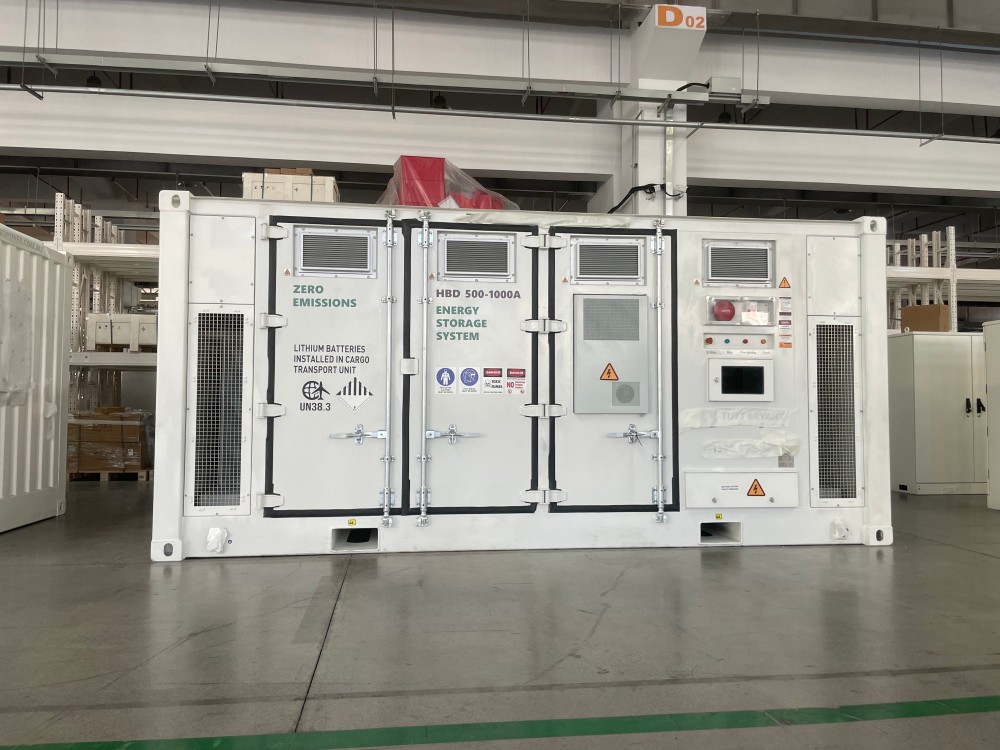
MPMC HBD-A Series HBD-500-1000 stationary battery energy storage system, sized for larger commercial and data centre applications.
Sizing the BESS Layer to an AIDC's Load Profile
MPMC's HBD-A Series spans 125 kW–1,125 kW AC output and 261 kWh–2,170 kWh capacity, built on LFP 314Ah cells at 8,000 cycles and 90% depth of discharge with liquid cooling throughout, giving a facility room to scale the battery layer to its actual rack density and load variability rather than a one-size configuration. A recommended data centre backup configuration pairs one to four containerised diesel generator sets, typically 1,000–3,000 kVA per unit, with an HBD-A BESS layer sized to the facility's specific peak-shaving requirement.
Retaining Reliable Backup While Reducing Generator Runtime
The standby genset configuration behind this arrangement still prioritises one-step load acceptance per ISO 8528-5 and extremely fast automatic mains failure response, with multi-unit parallel synchronisation available where redundancy requirements call for it. The BESS layer does not replace this backup capability; it reduces how often the generator array actually needs to run, which is where the low-carbon benefit comes from rather than from removing generator capacity altogether.
The HBD-A's EMS and self-developed SCADA also support VSG (virtual synchronous generator) mode, grid-forming, PQ and VF control modes, and black start capability, giving the BESS layer an active role in stabilising the facility's internal power quality rather than acting purely as a passive energy buffer. For an AIDC pursuing broader hybrid renewable ambitions alongside its low-carbon backup goal, this control depth is what allows solar, battery storage, and standby generation to operate together as one coordinated system rather than three independently managed layers.
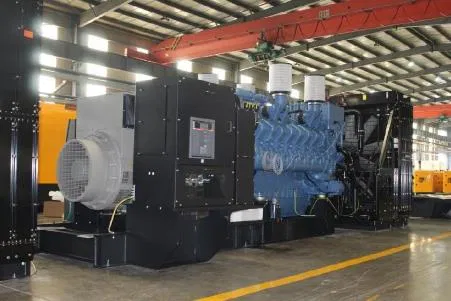
MPMC generator set on the assembly floor, representative of the standby generation layer paired with HBD-A battery storage in a hybrid AIDC backup configuration.
|
Deployment |
Scale |
Configuration |
|
Netherlands Frequency Regulation Plant |
8 MWh |
Grid-connected |
|
Kenya Microgrid |
6 MW, 4 sites |
HBD-A BESS + PV + diesel genset backup |
|
Netherlands Peak-Shaving Project |
3.2 MWh |
HBD-A + HBD-R combined |
Remote Monitoring for a Facility That Cannot Tolerate Surprises
MPMC's EMS and self-developed SCADA support real-time remote monitoring with ten-year data retention, giving an AIDC operator continuous visibility into how the BESS layer and generator array are actually sharing load, rather than discovering a configuration issue only when a genuine outage occurs. This monitoring depth matters more for an AIDC than for a less sensitive facility, given how little tolerance exists for an unplanned load event to reveal a gap in the hybrid system's coordination.
Broader Deployment Evidence Behind the AIDC Configuration
The same HBD-A platform proposed for an AIDC's low-carbon backup layer has a documented track record at larger scale, including an 8 MWh grid-connected frequency regulation plant in the Netherlands and a 6 MW, four-site microgrid in Kenya combining HBD-A BESS with PV and diesel genset backup under EMS weather-driven dispatch. For remote or island-adjacent AIDC sites specifically, the same EMS and SCADA platform supports Starlink satellite communication backup and an SL3 cybersecurity framework, relevant where on-site staffing or terrestrial connectivity cannot be assumed to be constant.
Evaluating a Low-Carbon Backup Solution for an AIDC
• Confirm the BESS layer's response time meets your facility's actual UPS-level switching requirement
• Size the battery capacity against your rack density and load variability, not a generic data centre benchmark
• Confirm the generator array still meets full standby reliability standards independent of the BESS layer
• Ask what remote monitoring and data retention is available for auditing hybrid system performance
• Request a documented reference from a comparable hybrid data centre or C&I peak-shaving deployment
• Confirm how PV, if planned, will integrate with the BESS layer through the EMS
https://www.mpmc-group.com/
MPMC Powertech Corp.