
Understanding the Static Voltage Stabilizer: A Maintenance-Free Path to Power Stability
Industrial facilities running medical imaging equipment, data center auxiliary power, communication base stations, or heavy machining lines share a common vulnerability: grid voltage that fluctuates, dips, or becomes three-phase imbalanced can halt production, damage sensitive electronics, and generate unplanned maintenance costs. Among the available stabilization technologies, the static voltage stabilizer has become a preferred solution for operations that require continuous, unattended operation without the wear associated with mechanical regulation methods.
What Makes Static Voltage Stabilization Different
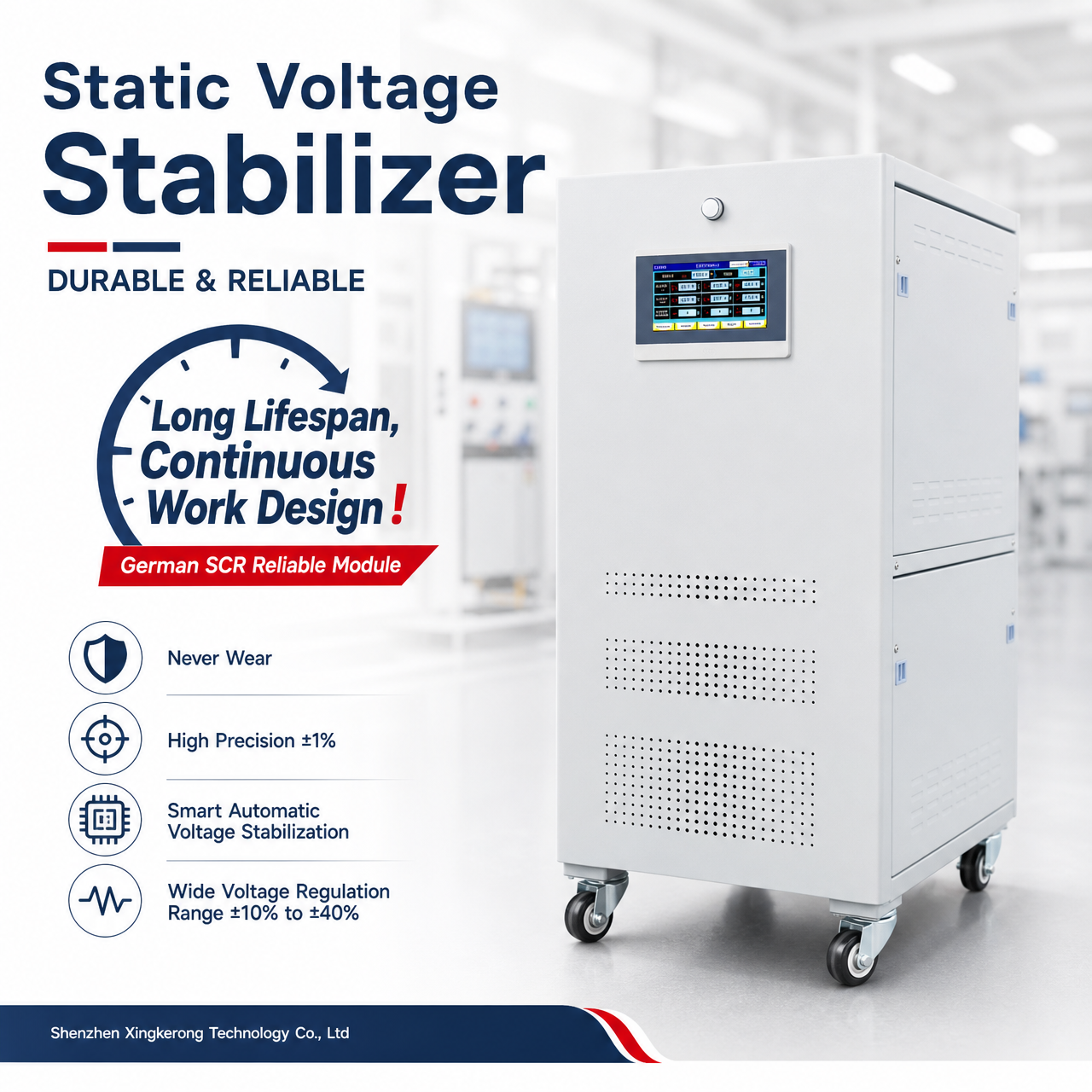
A static voltage stabilizer, such as the ASN/ASR series produced by SHENZHEN XINGKERONG TECHNOLOGY CO., LTD. (brand name SINCRON), relies on thyristor-based, contactless regulation rather than carbon-brush sliding contacts or servo motors. This "all-electronic" approach eliminates mechanical wearing parts, which directly addresses one of the most persistent pain points in voltage regulation: the periodic maintenance burden created by brush wear in servo-type stabilizers. Because there are no sliding contacts, static stabilizers are positioned for long-term unattended operation across a stated capacity range of 10–8,000 kVA.
Key Technical Characteristics
The SINCRON ASN/ASR static voltage stabilizer is built around several defined technical features:
- Voltage regulation range: ±20% by default, customizable up to ±50%, which addresses wide grid fluctuation conditions.
- Output accuracy: ±1%, suited to precision equipment that cannot tolerate voltage drift.
- Response time: approximately 20 ms, enabling fast correction of voltage deviations.
- Efficiency: ≥98%, which supports lower operating cost over continuous use.
- Independent per-phase regulation: keeps three-phase output balanced even when input is unbalanced, a critical capability for sites with uneven phase loading.
- Thyristor stepped regulation using German SEMIKRON SCR modules, which the company states provides consistent chip performance and strong surge withstand capability.
- Protection functions: eight protection items plus audible/visual alarm, designed to prevent secondary equipment damage.
- LCD touch screen: displays input/output voltage, load current, operating step, and alarm records, removing the need for an external upper computer for calibration.
- Optional Modbus RS232/RS485 communication: supports remote monitoring integration.
A notable differentiator stated by the company is that the main control board, trigger circuit, and assembly are developed and produced 100% in-house on its own production line, which the company positions as supporting controllable batch consistency and lead time.
Why Industries Choose Static Stabilization
The target scenarios for static voltage stabilizers reflect sectors where downtime or voltage error carries high consequence: medical imaging (MRI, CT), communication base stations, data center auxiliary power, mining aggregate plants, machining workshops, government currency minting facilities, and agricultural plants requiring an outdoor-rated version. In each of these settings, frequent grid fluctuation, voltage dips, and three-phase imbalance are recurring pain points that a contactless, independently phase-regulated stabilizer is designed to address.
Documented Project Experience
SINCRON's static voltage stabilizer line has been deployed across several documented project cases:
- A Russian construction company's aggregate plant (2025) selected an ASN-2,500 kVA three-phase static voltage stabilizer for a large aggregate production line, using the self-developed SCR stabilizer unit with German SEMIKRON SCR modules. The delivery lead time was 15–20 days, and the unit was supplied with a factory routine test report covering withstand voltage, temperature rise, and load testing, along with wiring diagrams and a nameplate checklist.
- An African machining plant (2025) selected a single ASN-4,000 kVA three-phase static voltage stabilizer for a distribution retrofit, specifically to handle the impact load created by multiple machine tools running simultaneously. This project also carried a 15–20 day delivery lead time with the same factory test documentation package.
- A government currency minting plant in Singapore (2025, confidential project) also used an ASN-4,000 kVA three-phase static voltage stabilizer for whole-plant distribution, reflecting the stringent power continuity and voltage stability requirements typical of government-type infrastructure. Due to confidentiality agreements, this case is described only by country and industry.
- An orchard and agricultural plant in Chile (2025) used an ASN-300 kVA outdoor static voltage stabilizer, where the outdoor installation had to withstand sun exposure, dust, and temperature variation.
These cases span construction materials, machining, government infrastructure, and agriculture, illustrating that the static stabilization approach scales from 300 kVA to 4,000 kVA depending on project load profile.
Positioning Within a Broader Power Equipment Platform
The static voltage stabilizer is one route within a broader voltage stabilization lineup that also includes servo-type stabilizers (SBW) for high-power applications where mechanical maintenance is accepted, IGBT static voltage stabilizers (HIS) for the fastest response in small-capacity precision instruments, and oil-immersed voltage stabilizers (OAVR) for harsh 7×24 hour industrial conditions. This structure allows a buyer to select a regulation technology matched to their specific maintenance tolerance, response-time requirement, and capacity need, rather than being limited to a single stabilization method.
SINCRON positions itself not as a trading company but as a source factory integrating R&D, production, and after-sales service across four production bases totaling approximately 28,000 m² (company-provided figure), located in Guangming (Shenzhen), Tangxia (Dongguan), Yancheng (Jiangsu), and Wenzhou (Zhejiang). The company holds National High-Tech Enterprise recognition (Certificate No. GR202444206332, valid to December 25, 2027) and ISO 9001:2015 certification (Certificate No. 15/25Q7219R21, valid to June 23, 2028), and its static voltage stabilizer line is backed by a company-wide 2-year complete-unit warranty with after-sales response within 1 day.
Procurement Considerations
For buyers evaluating a static voltage stabilizer, pricing is determined on a project basis rather than through a posted price list. Variables include capacity, voltage regulation range tier (±20% to ±50%), accuracy tier, phase count, and selected options such as communication modules. Minimum order quantity is one unit, and six trade terms (EXW, FCA, FOB, CIF, DDP, DDU) along with five payment methods (T/T, L/C, Western Union, Alipay-related cross-border collection, Alibaba online order) are supported, which accommodates both single-unit and bulk project procurement.
Conclusion
The static voltage stabilizer represents a maintenance-conscious, thyristor-based approach to voltage regulation that suits applications requiring continuous, unattended operation and tight output accuracy. With documented deployments ranging from 300 kVA to 4,000 kVA across aggregate processing, machining, government infrastructure, and agricultural sectors, and with in-house development of core control components, SINCRON's ASN/ASR static voltage stabilizer line offers buyers a traceable, factory-direct option for addressing grid fluctuation and three-phase imbalance challenges in demanding industrial and institutional settings.
www.sincron86.com
SHENZHEN XINGKERONG TECHNOLOGY CO., LTD.