

Yes — with six well-chosen photos and three or four numbers, you can identify almost any forklift mast bearing before you ever touch a catalog. That matters because mast guide bearings, chain sheave bearings and side thrust rollers look deceptively similar while fitting completely different positions on the mast. Learning how to identify a forklift mast bearing from photos saves distributors days of back-and-forth emails and saves repair shops from ordering the wrong part twice. Jinshengfeng engineers run this identification routine daily for customers across Europe, America and Southeast Asia, and this guide walks you through the same process.
Published: November 2026 | By Jinshengfeng Engineering Team
1. Which Photos Do You Need to Identify a Forklift Mast Bearing?
Six photos, taken at specific angles, identify almost any mast bearing: the stamped face, the outer ring profile, the seal face, the rolling elements, the mounting position on the truck, and one shot with a scale reference. Identification fails most often because of missing angles, not poor cameras — a single top-down photo hides everything a supplier needs to see.
Work through this shot list:
• Shot 1 — The stamped face. Photograph any ring face with markings straight-on, then again at an angle with light raking across it. Even half-legible codes help.
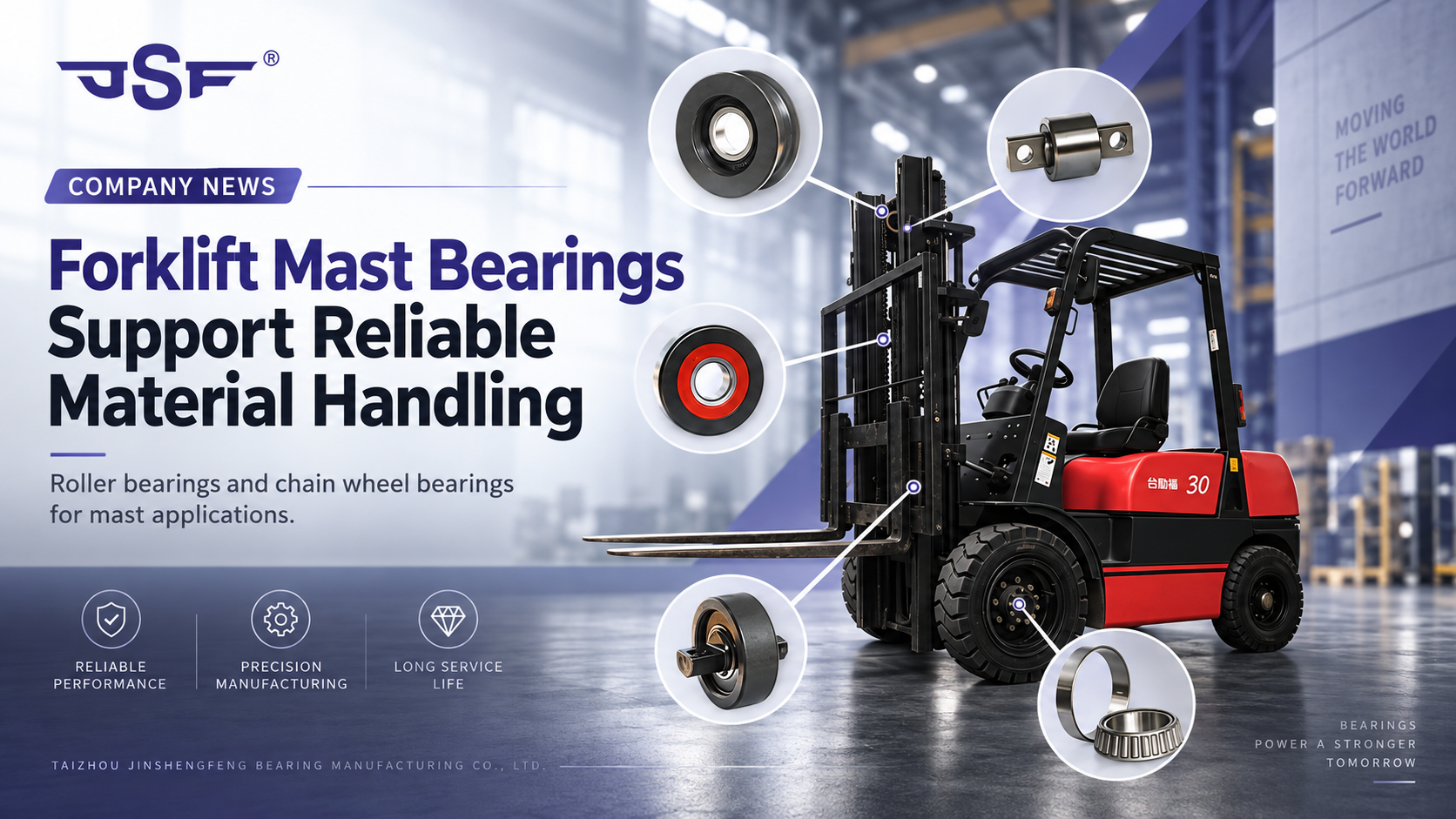
• Shot 2 — The side profile. The outer ring profile is the fastest family clue: a very thick outer ring means a mast guide or carriage roller that runs directly on the channel rail; a flanged face means a chain sheave that guides the lifting chain; a small stud-mounted roller means a side thrust roller.
• Shot 3 — The seal face. Capture whether the seal is rubber (RS), metal shielded (ZZ) or a rubber-and-metal combination (ZRS). Seal code changes with working environment, so suppliers need to see it.
• Shot 4 — The rolling elements. Photograph through the seal gap if needed: balls, cylindrical rollers, or a combined unit with a main radial roller plus a smaller axial roller. Combined rollers identify themselves instantly in photos.
• Shot 5 — The mounting position. A photo of where the bearing sits — carriage, inner mast stage, or chain path — often resolves ambiguous cases faster than any stamp.
• Shot 6 — Scale. Hold the caliper jaws around the bore in frame. Suppliers judge proportions from photos more reliably when a known reference is visible.
Alongside the six shots, send the measurement packet. Think of it as a forklift mast guide bearing dimensions ID OD width tolerance set: bore diameter, outside diameter, outer ring width, inner ring height, and the precision class if stamped. That is the full how to identify a forklift mast bearing from photos routine in practice: photos narrow the family, and only these numbers confirm the fit.
✅ Bottom line: Six targeted photos — stamp, profile, seal, rolling elements, position, scale — plus four numbers identify a mast bearing faster and more reliably than any catalog guess.
2. How Do You Read a Part Number When the Stamp Is Worn or Missing?
Work the stamp with raking light, chalk, or a pencil rubbing first — and if the code still will not read, geometry plus mounting position will identify the bearing even with no numbers at all. This is the core of how to read worn forklift bearing part numbers: recover what you can, then let shape and size finish the job.
• Recover the stamp. Shine a flashlight at a low angle across the ring face, or rub chalk over the engraving and photograph the contrast. Stamps that feel invisible to a fingertip often photograph clearly at an angle.
• Know which codes carry dimensions. Many OEM codes are pure part numbers with no dimensional meaning — but some encode size directly. A 180705KT mast roller corresponds to a 25 × 80 × 22 size, and a 782414H chain sheave bearing measures 70 × 178 × 53 mm. Never trust the pattern alone; verify every code against your own measurements.
• Map to the MG series. Once the forklift mast guide bearing dimensions ID OD width tolerance values are confirmed, most mast rollers map to MG-series equivalents, which run from roughly 12.6 mm to 100 mm bore. Jinshengfeng manufactures forklift bearings from 15–100 mm inner diameter and 30–200 mm outer diameter with P5 precision available, so standard and most replacement sizes are covered from stock tooling.
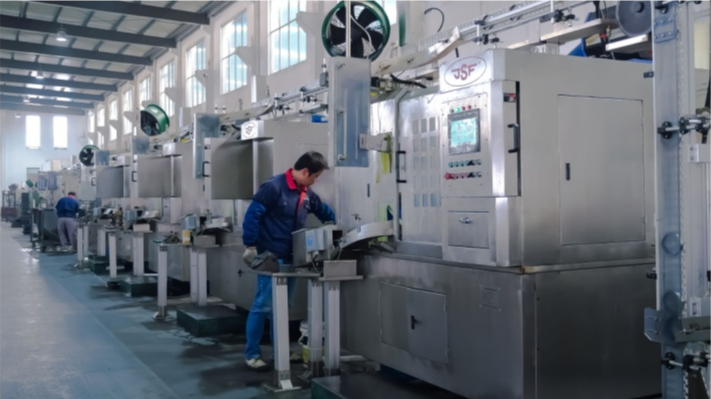
• No match anywhere? Photograph it anyway. Older trucks and special mast stages often carry bearings with no catalog equivalent. A factory with in-house grinding can reverse a new one from your sample or photos — Taizhou Jinshengfeng Bearing Manufacturing Co., Ltd. regularly produces non-standard mast bearings this way, under certified quality and environmental management systems, for both OEM programs and the aftermarket.
✅ Bottom line: Recover stamps with raking light or chalk, verify every code by measurement, and remember that geometry plus position can identify a bearing even when the marking is gone.
Frequently Asked Questions
Q: Is a photo alone ever enough to identify a mast bearing?
A: Photos narrow the bearing to a family — mast guide, chain sheave, or side thrust roller — but the full how to identify a forklift mast bearing from photos process ends with numbers: bore, outside diameter, width, and inner ring height. Two bearings can share a look and differ by two millimeters where it matters.
Q: The stamp is completely gone — is the bearing unidentifiable?
A: No. Skip how to read worn forklift bearing part numbers entirely and identify by geometry: rolling element type, outer ring profile, seal configuration, and mounting position, plus your measurements. Suppliers cross-reference against MG-series charts from dimensions alone every day.
Q: Can I send photos to a factory and get a quote back?
A: Yes. Send your six photos and measurement packet to Jinshengfeng (Taizhou Jinshengfeng Bearing Manufacturing Co., Ltd.) for a free fitment check and quotation, including OEM replacements and non-standard production from samples.
Ready to identify your bearing? Email your six photos, the four dimensions, and the truck make and model to tzjsf@163.com. The Jinshengfeng team will confirm the equivalent or quote a replacement — and you can browse the standard forklift bearing range or the mast side roller bearings while you wait.
www.jsfroller.com
Taizhou Jinshengfeng Bearing Manufacturing Co., Ltd.