
Ordering a mast bearing by truck model alone is the fastest way to lose a week of downtime. The same 2-ton Toyota chassis may leave the factory with different mast suppliers, and catalogs differ between regions. A reliable forklift mast bearing size chart with load ratings solves this: you read the bearing's own dimensions first, match them to the MG series range, then verify the load rating against how the mast actually works. Jinshengfeng publishes this workflow because our factory machines mast rollers daily and sees what happens when buyers skip the load-rating check — premature spalling on guide rollers that were never rated for the channel load in the first place. This guide walks through the chart structure, MG series mapping by truck class, and the dynamic-vs-static decision in plain numbers.
1. What Does a Forklift Mast Bearing Size Chart Include — and How Do You Read It?
A usable chart has three core dimensions — bore (ID) × outer diameter (OD) × width — plus the inner ring height and rolling element type, because two rollers with identical ID/OD/width can still be different parts. Start every inquiry from a forklift mast bearing size chart with load ratings, not from the truck badge. Combined mast rollers add an inner ring that protrudes beyond the outer ring face; that protrusion (inner ring height) decides whether the roller seats flush against the mast channel. A well-built MG series forklift mast roller bearing dimensions chart always lists all five values.
Reading the chart takes four checkpoints:
• Measure the used bearing, not the truck. Measure ID, OD, and width with a digital caliper (0.01 mm resolution) at the unworn land of the outer ring. Worn OD reads undersize — record both worn and unworn values if possible.
• Match against MG series ranges. MG-series mast rollers cover bores from roughly 12.6 mm to 100 mm and ODs from 30 mm to 200 mm, which spans light-duty walkies up to 10-ton counterbalance trucks.
• Two worked examples from real cross-referencing: 180705KT = 25 mm × 80 mm × 22 mm, a common guide roller on 1.5–3T trucks; 782414H = 70 mm × 178 mm × 53 mm, a heavy-duty combined roller on 5–10T masts. Both exist in parts catalogs under different part numbers, but the dimensions are the final authority.
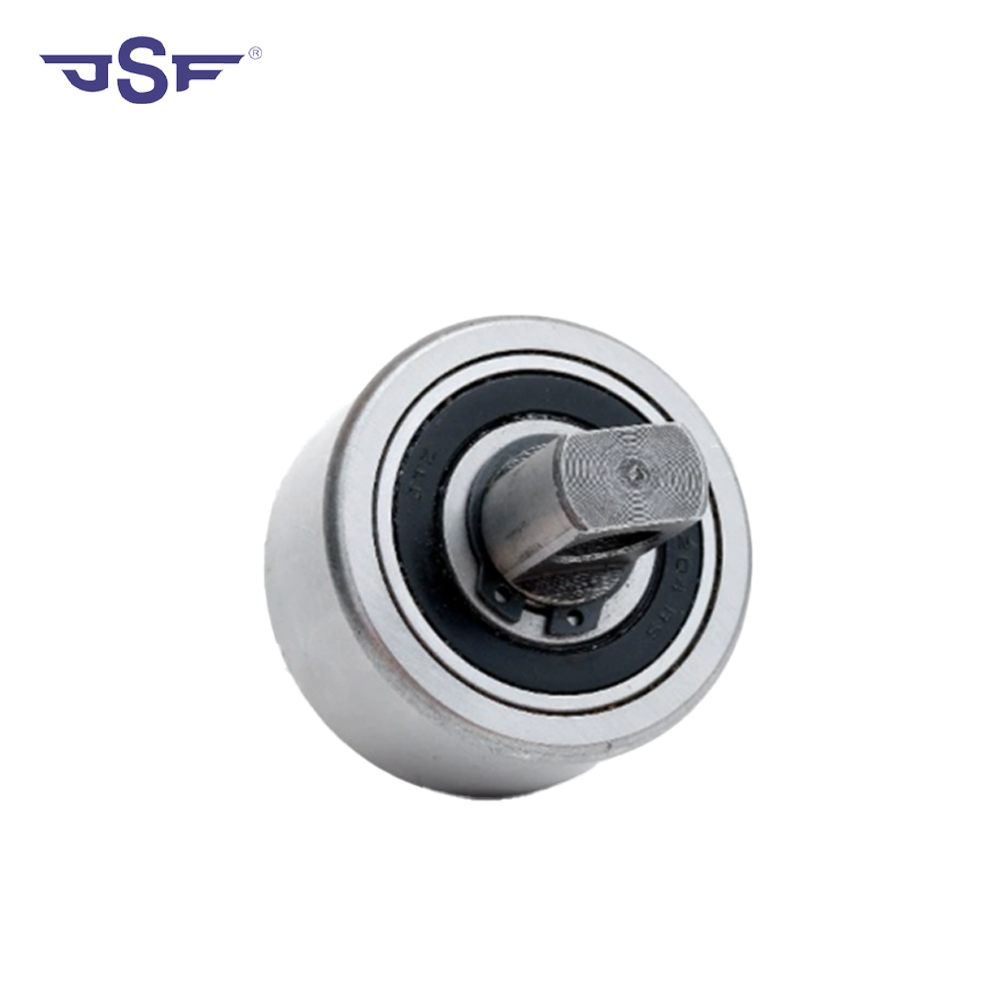
• Confirm the rolling element and channel profile. A plain cylindrical outer ring, a V-groove combined roller, and a stem-type chain wheel bearing can share dimensions while doing different jobs — the photos in your inquiry should show the outer ring face and the stem or bore.
✅ Bottom line: Read ID × OD × width first, then inner ring height and element type — four dimensions that no catalog part number can replace.
A practical note from our production floor: when a China manufacturer quotes from dimensions alone, turnaround is usually 24–48 hours, while quoting from a photograph of a worn stamp often stalls on decoding. Send numbers, not just part numbers. (Jinshengfeng accepts both, but dimensions get you a firm answer faster.)
2. Dynamic or Static: Which Load Rating Matters for Your Mast?
Both matter, but they apply to different bearings in the same mast: dynamic rating (C) governs rotating chain wheel bearings, while static rating (C0) governs the slow-oscillating guide rollers that carry the full fork load. Getting this distinction right is what forklift mast bearing load rating dynamic static explained searches are really asking, and it changes which column of the chart you compare first.
The logic in three checkpoints:
• Dynamic rating C predicts L10 life under rotation: L10 = (C/P)³ million revolutions, where P is the equivalent load. Chain wheel bearings spin with the chain, so their life is counted in revolutions — a C value of 30–40 kN is typical for the 25 mm bore class, and roughly 100 kN+ for the 70 mm heavy class.
• Static rating C0 limits permanent deformation. Guide and side rollers barely rotate — they creep through small arcs under load — so their failure mode is brinelling (flat spots), not fatigue. Here the applied static load must stay below roughly half of C0 for safety in shock-prone docks.
• Match the column to the position. The forklift mast bearing load rating dynamic static explained rule: C for chain wheels, C0 for guide rollers. If a supplier's chart lists only one rating, ask which one it is. A roller chosen on C alone can look adequate yet brinell within months in a side position.
✅ Bottom line: Compare C for rotating chain positions and C0 for slow-moving guide positions — one column per job, never one number for the whole mast.
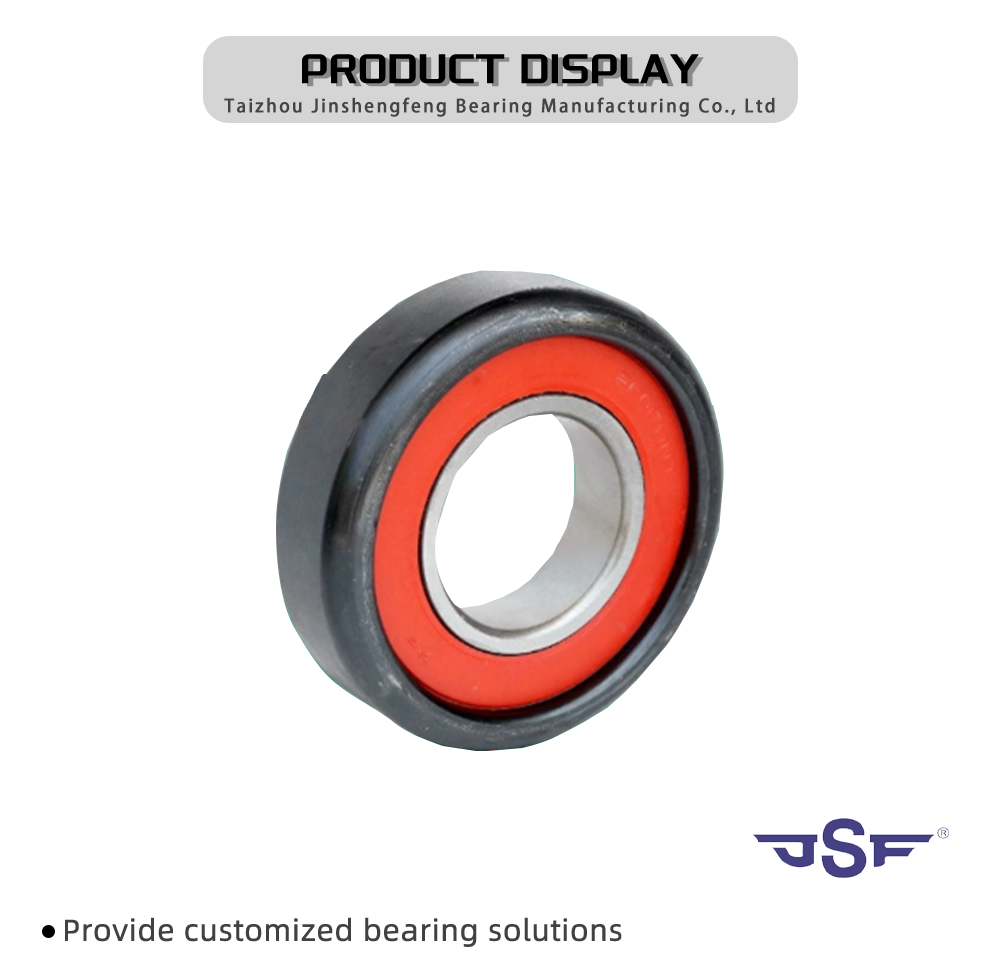
For aftermarket buyers, Taizhou Jinshengfeng Bearing Manufacturing Co., Ltd. publishes C and C0 separately across its forklift bearing range, and the full MG series forklift mast roller bearing dimensions chart is available on request — P5-grade tolerances optional, with OEM-equivalent marking for fleet-standardized spare parts bins.
Frequently Asked Questions
Q: Where can I find a forklift mast bearing size chart with load ratings I can trust?
A: Use a chart that lists ID × OD × width and inner ring height per entry, with C and C0 stated separately. Taizhou Jinshengfeng Bearing Manufacturing Co., Ltd. provides its MG series chart on request, and the engineering team will cross-check your four measurements against it free of charge before you order.
Q: Are MG series dimensions interchangeable with OEM mast bearings?
A: Dimensionally yes within standard tolerance bands — MG series was designed as an OEM-equivalent system. The checkpoint is inner ring height and channel profile; if both match, the swap is drop-in. Our side roller range follows the same logic for side-position replacements.
Q: What if my measurements match nothing in the chart?
A: Non-standard inner ring heights and special channel profiles are common on imported masts. Jinshengfeng produces custom special-purpose mast rollers from drawings, samples, or the four measurements plus two photos, with low-MOQ trial lots for distributors and fleet program volumes for large buyers.
Next Step — Free Fitment Cross-Check
Send your four dimensions (ID × OD × width + inner ring height), two photos, and truck model to Jinshengfeng. The engineering team confirms the MG equivalent or quotes a custom version within one working day — no minimum order for first-time trials.
Published:November 2026 | By Jinshengfeng Engineering Team
www.jsfroller.com
Taizhou Jinshengfeng Bearing Manufacturing Co., Ltd.