
Mini UPS for ONT, Modem, Router, and Gateway Backup: Essential Solutions for Network Continuity
In today's hyperconnected world, internet downtime is more than an inconvenience—it disrupts remote work, online learning, smart home systems, and business operations. For telecom operators, Internet Service Providers (ISPs), and broadband network companies, maintaining uninterrupted connectivity at the customer premises has become a critical service differentiator. Yet one of the most persistent challenges remains surprisingly simple: power interruptions that cause routers, ONTs (Optical Network Terminals), modems, and gateways to reboot repeatedly, triggering service complaints and costly field support calls.
Understanding the Customer Premises Power Challenge
Network equipment deployed at subscriber locations—including fiber ONTs, DSL modems, cable gateways, wireless routers, and CPE (Customer Premises Equipment)—typically operates on low-voltage DC power supplied by external adapters. While these devices are engineered for reliability, they remain vulnerable to power quality issues that plague many residential and small business environments.
Power interruptions, even brief ones lasting only seconds, force network devices to restart. During these reboots, internet connectivity drops, active sessions terminate, and users experience service disruption. In regions with unstable electrical grids, voltage fluctuations, brownouts, and frequent outages compound the problem, leading to repeated device restarts throughout the day.
For ISPs and telecom operators, these power-related disruptions create multiple operational pressures: increased customer complaints, higher call center volumes, elevated remote troubleshooting workloads, and unnecessary field service dispatches. Each truck roll to investigate a "connectivity issue" that turns out to be power-related represents significant cost without adding subscriber value.
The Role of Mini DC UPS in Network Continuity
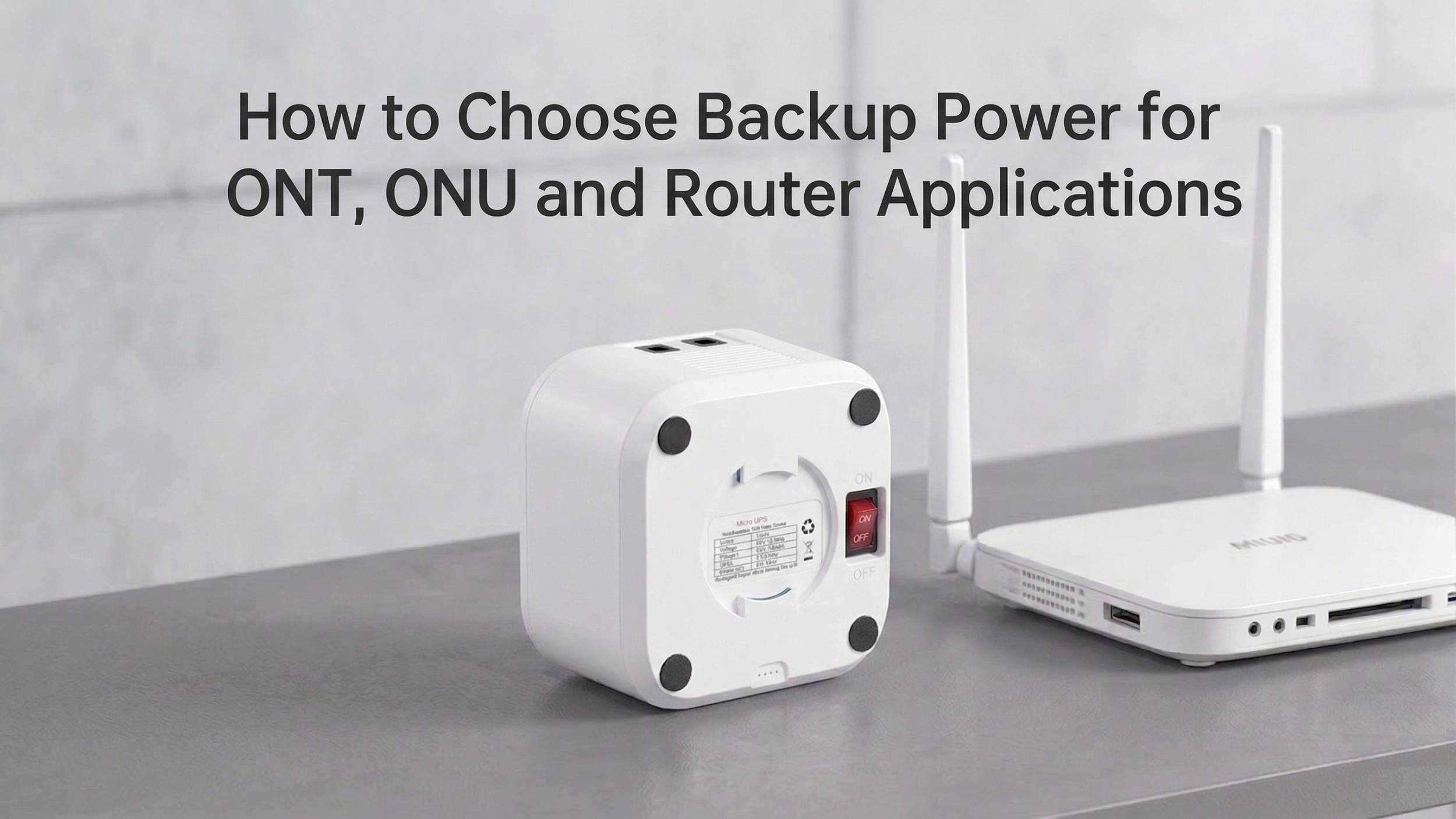
Mini DC UPS (Uninterruptible Power Supply) systems provide targeted backup power solutions specifically designed for customer-side network equipment. Unlike traditional AC UPS systems—which are often bulky, expensive, and over-engineered for small networking devices—Mini DC UPS products deliver compact, cost-effective protection tailored to the actual voltage, current, and runtime requirements of routers, ONTs, modems, and gateways.
These specialized backup power units sit between the power adapter and the network device, monitoring incoming power continuously. When grid power fails or voltage drops below safe operating thresholds, the Mini UPS instantly switches to battery backup mode, maintaining uninterrupted DC power to the connected equipment. This seamless transition keeps the network device online throughout short outages and provides graceful shutdown capability during extended power failures.
Key Applications and Deployment Scenarios
Fiber Broadband and FTTH Networks: As fiber-to-the-home deployments expand globally, ONTs installed at customer premises require reliable backup power. Mini DC UPS solutions designed for ONT backup help fiber network operators maintain service continuity during local power interruptions, reducing service calls and improving customer satisfaction scores.
ISP Router and Gateway Protection: Internet Service Providers deploying routers, WiFi gateways, and combination modem-router units face constant pressure to minimize downtime. Backup power solutions matched to device specifications—including correct voltage (5V, 9V, 12V, 24V), appropriate current capacity, and compatible connectors—ensure these critical customer-facing devices remain operational when grid power fails.
Broadband CPE Backup: Customer Premises Equipment spanning cable modems, DSL gateways, wireless CPE, and hybrid fiber-coax terminals all benefit from targeted backup power protection. Properly sized Mini UPS systems help broadband providers deliver more consistent service quality in areas prone to power instability.
Security and Smart Home Integration: As home networks increasingly support security cameras, smart home hubs, and IoT devices, maintaining gateway and router uptime becomes essential for system functionality. Backup power for the central network gateway ensures the entire connected ecosystem remains operational during power events.
Critical Selection Factors for Effective Backup Power
Selecting appropriate backup power solutions requires careful matching between the Mini UPS capabilities and the actual device requirements. Several technical factors determine whether a backup power system will perform reliably in real-world deployment:
Voltage and Current Matching: Network devices operate at specific DC voltages—commonly 5V, 9V, 12V, or 24V. The backup power solution must deliver stable output at the correct voltage while supplying adequate current to support both normal operation and startup surge conditions. Undersized units may fail during device boot sequences when current draw peaks temporarily.
Connector Compatibility: Physical connection interfaces vary widely across network equipment manufacturers and models. DC barrel connectors differ in outer diameter, inner diameter, and polarity. USB-C Power Delivery has introduced additional complexity with voltage negotiation protocols. Effective backup power deployment requires precise connector matching or customized cable solutions.
Runtime Requirements: Backup time needs vary significantly based on deployment scenario and local power quality. In areas experiencing frequent brief outages, even 30-60 minutes of backup time can eliminate most service interruptions. Regions with longer, less frequent outages may require extended runtime capabilities, necessitating larger battery capacity and potentially different battery chemistry selection.
Installation Environment: Customer premises deployment introduces practical constraints around size, weight, mounting options, and aesthetic considerations. Compact inline designs work well for space-constrained installations, while desktop units suit environments with available surface area. Wall-mounting capabilities offer flexibility for utility room or garage installations.
MYLION's Specialized Approach to Network Backup Power
Shanghai Mylion Technology Co., Ltd., operating under the MYLION brand, has developed a focused portfolio of Mini DC UPS and telecom BBU (Battery Backup Unit) solutions specifically targeting customer-side network equipment protection. With over 13 years of experience in lithium battery systems and backup power engineering, MYLION addresses the practical deployment challenges ISPs and telecom operators face when protecting subscriber equipment.
The company's product range reflects real-world diversity in network equipment specifications. The 12V Standard Mini DC UPS Series (models MU68, MU26, MU48) addresses mainstream router, ONT, modem, and gateway applications where 12V DC input is standard. These compact units integrate lithium battery packs with BMS (Battery Management System) protection against overcharge, over-discharge, overcurrent, and short circuit conditions.
For higher-power applications—advanced gateways, WiFi mesh systems, and performance routers drawing elevated current—MYLION offers the High-Power 12V Telecom BBU Series (models MU35, MU65). These units provide increased current capacity essential for devices where standard low-power Mini UPS products would be insufficient. Proper current capacity matching prevents backup system overload during startup surge periods or peak device operation.
Recognizing the space constraints common in FTTH installations, MYLION developed the Inline FTTH Mini UPS Series (model MUJ46), featuring an ultra-compact inline design that connects directly between the power adapter and network device. This configuration eliminates the need for additional desktop space and simplifies installation in residential environments where aesthetics and minimal visibility matter.
The evolving shift toward USB-C Power Delivery in modern network equipment prompted MYLION's development of the USB-C PD Mini UPS Series (model MUC85). As next-generation routers, smart hubs, and portable terminals adopt USB-C input architectures, backup power solutions must accommodate voltage negotiation protocols and connector standards different from traditional DC barrel interfaces.
For specialized applications requiring higher DC voltages, the 24V/48V DC Backup Power Series (model MU248) supports wireless CPE, small communication terminals, and professional equipment operating at elevated DC voltages. This extends backup power protection beyond standard 12V consumer networking devices into more specialized telecom and industrial applications.
Battery chemistry selection represents another dimension of MYLION's solution portfolio. The LiFePO4 Mini UPS Series (model ML1202AC) employs lithium iron phosphate battery technology, offering enhanced thermal stability and extended cycle life compared to standard lithium-ion batteries. For applications requiring long-term standby reliability and repeated backup cycles, LiFePO4 chemistry provides safety and longevity advantages valued in professional deployment scenarios.
Project-Based Customization and OEM/ODM Capabilities
Beyond standard product offerings, MYLION supports project-based customization essential for large-scale ISP and telecom deployments. Private labeling enables service providers to brand backup power solutions with their own identity, strengthening customer recognition and equipment standardization across their network.
Connector and cable customization addresses the physical interface diversity across network equipment manufacturers. Custom cable assemblies ensure plug-and-play compatibility with specific router, ONT, or gateway models, eliminating adapter complexity and reducing installation errors during field deployment.
Capacity adjustment allows battery sizing optimization based on actual runtime requirements and cost constraints. Rather than forcing customers into fixed capacity options, project-based engineering matches battery specifications to measured device current draw and target backup duration.
Documentation support—including product specifications, user manuals, test reports, certification coordination, and shipping documentation—facilitates the regulatory compliance and supply chain requirements inherent in international B2B projects. For lithium battery products crossing borders, proper UN38.3, MSDS, and transport documentation becomes essential for legal shipment and customs clearance.
Implementation Considerations for ISPs and Telecom Operators
Successful backup power deployment requires systematic planning beyond simple product selection. ISPs and network operators should consider several implementation factors:
Device Characterization: Accurate measurement of actual working current—not just power adapter ratings—provides the foundation for proper backup unit sizing. Many devices draw significantly less current than their adapter ratings suggest, but startup surge current may temporarily exceed nominal values. Testing under real operating conditions prevents both oversizing (unnecessary cost) and undersizing (inadequate protection).
Backup Time Objectives: Clear definition of required runtime drives battery capacity selection and cost-performance optimization. Organizations should analyze local power outage patterns—frequency, duration, and time-of-day distribution—to establish rational backup time targets. Protecting against typical 15-30 minute outages requires far less battery capacity than preparing for multi-hour grid failures.
Installation Methodology: Deployment approach affects both initial rollout cost and long-term reliability. Self-installation by customers reduces deployment cost but requires clear instructions and plug-compatible design. Technician installation during equipment provisioning ensures proper connection but increases labor costs. Choosing the appropriate model—desktop, inline, or wall-mount—should align with typical installation environments and customer capabilities.
Certification and Safety Compliance: Different markets impose varying regulatory requirements for electrical products and lithium battery systems. Products deployed in European markets typically require CE marking and RoHS compliance. North American markets may necessitate FCC registration. International shipping of lithium batteries triggers UN38.3 transport testing and documentation requirements. Early coordination on certification needs prevents costly delays during project scaling.
The Business Case for Network Backup Power Investment
For ISPs and telecom operators evaluating backup power deployment, the value proposition extends beyond simple power protection. Strategic benefits include:
Reduced Operational Costs: Field service dispatches for power-related connectivity issues represent significant expense. Each avoided truck roll generates immediate savings while freeing technical resources for value-adding activities. Call center volume reduction from fewer power-related complaints lowers support costs and improves agent efficiency.
Improved Service Quality Metrics: Customer satisfaction scores, Net Promoter Scores, and service uptime statistics all benefit from reduced power-interruption incidents. In competitive markets where service differentiation is challenging, measurable reliability improvements strengthen customer retention and reduce churn rates.
Competitive Differentiation: Proactive backup power deployment—particularly in markets with known power quality issues—creates tangible service advantages. ISPs offering "power-protected broadband" packages can command premium positioning and potentially justify higher service pricing in unstable-power regions.
Future-Proofing Network Investment: As smart home adoption accelerates and home-based work becomes permanent for many subscribers, internet connectivity reliability grows increasingly critical. Backup power infrastructure positions service providers to support evolving customer needs and emerging services dependent on continuous connectivity.
Conclusion
Network equipment backup power represents a practical, cost-effective approach to addressing one of the most common causes of customer-side service disruption: power interruptions forcing router, ONT, modem, and gateway reboots. Mini DC UPS solutions specifically engineered for these applications—with appropriate voltage, current capacity, connector compatibility, and installation form factors—enable ISPs and telecom operators to significantly improve service continuity without massive infrastructure investment.
Successful deployment requires careful matching between backup power specifications and actual device requirements, supported by proper battery capacity sizing, installation methodology selection, and regulatory compliance coordination. Organizations like MYLION, specializing in telecom-focused backup power solutions with project customization capabilities, provide the engineering support and product diversity necessary for large-scale network protection deployment.
As broadband connectivity evolves from convenience to necessity, ensuring reliable power for customer-side network equipment transitions from optional enhancement to competitive requirement. Strategic backup power investment delivers measurable returns through reduced operational costs, improved service quality metrics, and strengthened competitive positioning in an increasingly reliability-sensitive market.
www.myliontech.com
Shanghai Mylion New Energy Co.,Ltd.