
Understanding the Core Question: Mini UPS vs UPS
When telecom operators, Internet Service Providers (ISPs), broadband network companies, fiber network operators, and system integrators evaluate backup power for network edge equipment, the comparison between a Mini UPS and a traditional UPS is often the first decision point. Network equipment such as routers, modems, and ONTs commonly reboot or lose service during short power outages, voltage drops, or unstable grid conditions. Choosing the wrong form factor—or misjudging voltage, current, peak load, or connector compatibility—can lead to application failure in the field. This guide examines how Mini UPS solutions differ from conventional UPS approaches and how to apply that distinction to real deployment decisions.
Why Traditional UPS Thinking Doesn't Always Fit Edge Devices
Conventional UPS systems are typically designed around AC power distribution for broader infrastructure needs. However, the devices most vulnerable to short outages—routers, ONTs, ONUs, modems, gateways, CPE devices, and security or CCTV equipment—usually run on compact DC voltages, most commonly 12V. Applying a generalized UPS mindset to these devices without verifying actual device voltage, working current, peak/startup behavior, and installation environment increases the risk of connector mismatches, insufficient current delivery, or oversized, impractical hardware at the subscriber premises. This is precisely the industry pain point that Shanghai Mylion New Energy Co., Ltd., operating under the brand MYLION, was established to address. MYLION positions itself as a global B2B provider of Mini UPS products, DC backup power solutions, and project support for telecom, ISP, broadband, and security applications, rather than a generic power equipment vendor.
What Makes a Mini UPS Different
A Mini UPS is purpose-built for the specific electrical profile of network and security equipment, rather than general-purpose load support. MYLION's approach centers on evaluating solutions based on real device voltage, working current, peak/startup behavior, and installation environment, followed by technical confirmation and connector/cable matching to reduce selection errors. This distinction matters because small deviations in current rating or connector type—details easy to overlook when applying traditional UPS logic—can determine whether a backup unit actually protects a device during an outage or simply fails to engage.
Key Selection Criteria When Comparing Mini UPS vs UPS Options
Matching Voltage and Current to the Device
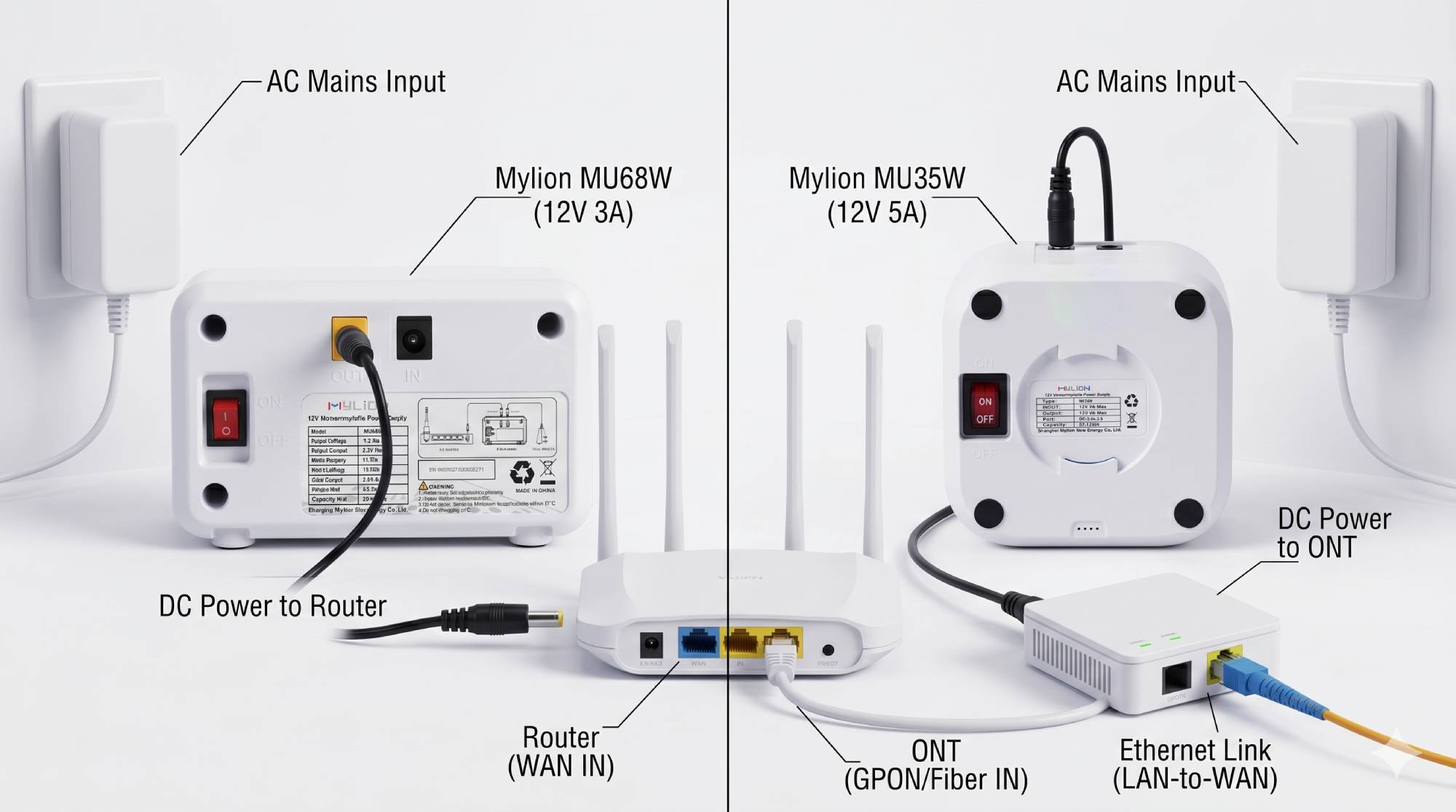
The foundation of any selection decision is matching the backup unit's input and output specifications to the actual device being protected. MYLION's 12V Standard Series illustrates this principle. The MU26W model supports a 12V DC input up to 3.5A and delivers 2.5A continuous (3A maximum) output, paired with 18.72Wh of battery capacity and DC5521 input / DC5525 output interfaces—suited to entry-level routers or ONTs. The MU48W steps up to 29.6Wh capacity with a center-positive DC5525 output for ISP and broadband network equipment, while the MU68W offers 44.4Wh capacity and up to 36W output (12V/3A) for professional ISP projects requiring extended runtime.
Accounting for High-Power or High-Current Equipment
Not all network equipment operates within standard current thresholds. High-performance WiFi equipment and storage-integrated gateways often exceed the 2.5A range typical of standard loads. MYLION's 12V High-Power Series, represented by the MU65W, addresses this with a 12V DC input supporting up to 6A and an output of 4A continuous (5A maximum, 60W total), backed by 56.16Wh of battery energy. For scenarios demanding both high current and extended backup duration, the 12V High-Power Long-Runtime Series (MU35W/MU35L) combines 4A continuous/5A maximum output with 75.6Wh capacity, supporting professional gateways that require high peak current alongside long backup time.
Planning for Extended Runtime Needs
For residential or remote-area deployments facing long-duration outages, runtime becomes as important as current capacity. The 12V Long-Runtime Series (MU635W/MU635L) delivers 75.6Wh of battery energy with standard 2.5A continuous/3A maximum output, designed specifically for extended service continuity on standard CPE devices.
Supporting Multi-Device and Multi-Port Scenarios
Many small office or home office (SOHO) setups require simultaneous backup for a router and a secondary USB-powered accessory. MYLION's 12V + USB Multi-Output Series addresses this with models like the MUJ46, offering 12V DC output (1.5A continuous/2A maximum) alongside dual 5V/3A USB-A and USB-C outputs within an 18W total system limit, backed by 37.44Wh of battery energy. The MUJ435 extends this concept with 50.4Wh of capacity under the same 18W output ceiling and port configuration.
Considering AC-Input and Dual-Output Configurations
For installations combining an ONT and router from a single wall outlet, MYLION's AC-Input Dual Output Series, led by the ML1202AC, uses LiFePO4 battery chemistry with 100–240V AC input and dual 12V DC outputs (2A each, 24W total system limit), supported by 25.6Wh of battery energy—eliminating the need for a separate external DC adapter per device.
Why Technical Confirmation Matters More Than Specification Lists
Specifications alone do not guarantee successful deployment. MYLION's value proposition centers on supporting more reliable DC backup deployment and reducing avoidable selection risks for professional project customers through technical confirmation and connector/cable matching, rather than simply publishing a catalog of options. This is especially relevant given that platform compatibility—whether a unit works correctly with a given router, ONT, ONU, modem, gateway, CPE device, or security/CCTV system—remains subject to electrical verification in each case.
Backed by Engineering Experience and Compliance Awareness
MYLION brings 13+ years of experience in Lithium Battery technology and 10+ years of experience in Mini UPS development to its evaluation process, combined with adherence to lithium battery transport documentation and model-specific compliance requirements such as UN38.3 and MSDS certifications where applicable. This foundation supports the company's broader service scope, which includes requirement analysis, model matching, sample testing support, connector/cable matching, private labeling, and documentation coordination—delivered through managed pilot evaluation and mass-production preparation for B2B project support and OEM/ODM engagements.
Looking Ahead: Emerging Directions
The Mini UPS category continues to evolve alongside device requirements. MYLION's development pipeline includes project-evaluation directions such as the MUC85, a USB-C PD Mini UPS under development for modern WiFi 6/7 devices requiring USB-C Power Delivery (65W standard/100W max input), and the MU248, a 24V/48V telecom backup direction under development for higher-voltage wireless CPE and radio bridge equipment, featuring LiFePO4 chemistry and independent 24V (3A) and 48V (1A) outputs within a 100W system limit.
Conclusion
For telecom operators, ISPs, broadband network companies, fiber network operators, and system integrators, the Mini UPS vs UPS decision ultimately comes down to matching real device electrical requirements—voltage, current, peak behavior, and connector type—to a purpose-built backup solution rather than a generalized power product. Shanghai Mylion New Energy Co., Ltd., through its MYLION brand, structures its entire product matrix and service model around this principle, offering project customers a technically verified path from requirement analysis through sample validation and mass-production preparation.
www.myliontech.com
Shanghai Mylion New Energy Co., Ltd.