

For industrial IoT, remote monitoring, transportation, energy infrastructure, security systems, and other distributed applications, choosing a 5G router isn't just about maximum download speed. The more important question is whether the router can keep critical equipment connected when the cellular environment changes, a SIM connection becomes unavailable, or the installation operates in a difficult physical environment.
That is why system integrators, telecom projects, industrial automation companies, and infrastructure operators are increasingly looking for recommended dual SIM 5 G router manufacturers.
A dual SIM design can provide a second cellular connection for network redundancy, while 5G provides the bandwidth and latency characteristics required by demanding industrial applications. Industry guidance also shows that industrial connectivity decisions need to balance coverage, latency, reliability, bandwidth, security, power requirements, and the operating environment rather than focusing on one specification alone.
For buyers building a supplier shortlist, the manufacturer behind the router matters just as much as the router itself. Hardware quality, firmware development, remote management, industrial interfaces, cellular compatibility, and long-term support can determine whether a large-scale deployment remains manageable after installation.
What Makes a Dual SIM 5G Router Suitable for Industrial Use?
A consumer 5G router may provide fast wireless access, but industrial deployments often have very different requirements. Remote cabinets, vehicles, photovoltaic sites, traffic systems, power infrastructure, and unattended equipment may remain online for long periods without an engineer physically present.
A suitable industrial router therefore needs to handle several tasks at the same time:
- Maintain cellular connectivity when one network path becomes unavailable.
- Support high-bandwidth applications such as video surveillance and industrial data transmission.
- Work with industrial equipment through Ethernet, serial, and digital interfaces.
- Protect data moving between remote sites and central platforms.
- Recover automatically from network or hardware faults.
- Allow administrators to diagnose and manage equipment remotely.
- Operate reliably across a wide range of temperatures and electrical conditions.
These requirements are consistent with the direction of modern industrial IoT networking. The GSMA notes that industrial connectivity architectures increasingly combine gateways, edge computing, Ethernet, Wi-Fi, public cellular networks, and private 5G according to the requirements of each deployment.
This is where dual SIM technology becomes particularly useful.
Dual SIM Is About Network Resilience, Not Just Two SIM Cards
A dual SIM router normally provides two cellular subscriptions or SIM interfaces that can be used to improve network availability. However, simply installing two SIM cards does not automatically create effective redundancy.
The router needs an intelligent failover mechanism. When the primary cellular connection becomes unavailable, the device should be capable of switching to the backup connection automatically instead of requiring an engineer to visit the site.
For remote infrastructure, the practical value is straightforward: a temporary carrier-side problem, signal deterioration, or unavailable primary connection should not necessarily result in a prolonged loss of connectivity.
For this reason, buyers should ask manufacturers how the dual SIM function actually operates. Important questions include whether switching is automatic, how quickly failover occurs, whether the router can detect link health rather than merely signal presence, and whether network recovery can be handled without a physical restart.
Why 5G Matters for Industrial IoT Routers
5G is not required for every industrial application. A low-data-rate sensor may work perfectly well with a lower-bandwidth connection. However, applications involving multiple cameras, large data transfers, cloud-edge systems, machine monitoring, or mobile equipment can benefit from the additional capabilities of 5G.
The 5G architecture has been developed to support different industrial requirements around bandwidth, latency, reliability, and device density. 3GPP distinguishes between 5G Non-Standalone and Standalone architectures; NSA uses an LTE anchor together with 5G NR, while SA operates with a 5G core and does not require an LTE control-plane anchor.
For an industrial router, this means buyers should look beyond the label “5G” and examine the actual network modes, supported interfaces, deployment environment, and software functions.
A useful selection process should therefore consider four layers.
1. Cellular Capability
The first layer is the cellular connection itself. Buyers should verify supported 5G modes, regional network compatibility, antenna configuration, SIM architecture, and fallback behaviour.
Dual SIM is particularly valuable when continuous connectivity is important. A router that supports automatic switching between cellular connections can reduce the operational effect of an individual network failure.
2. Industrial Hardware
The second layer is physical reliability. Industrial routers may be installed inside electrical cabinets, roadside equipment, vehicles, outdoor systems, or remote monitoring stations.
E-Lins Technology designs its industrial communication equipment around these types of environments. Its hardware uses industrial-grade chips and components with a stated operating temperature range of -35°C to +75°C, together with 15KV ESD protection and 1.5KV electromagnetic isolation.
These characteristics are relevant because industrial networking equipment is often exposed to temperature fluctuations and electrical interference that are uncommon in ordinary office environments.
3. Software and Network Recovery
Firmware is another major consideration. A technically capable radio module is not enough if the software is unstable or difficult to maintain.
E-Lins develops its router firmware independently rather than relying entirely on a generic public Linux distribution. Its technical system includes link self-healing mechanisms and hardware watchdog timers designed to improve recovery from connectivity or device-level problems.
For deployments with hundreds or thousands of remote routers, this matters because a small percentage of recurring connectivity faults can become a substantial maintenance burden.
4. Remote Management
Industrial connectivity increasingly requires centralized management. The objective is not simply to put a router online but to operate the entire installed fleet efficiently.
E-Lins industrial communication equipment supports management and integration technologies including TR-069, SNMP, SSH, and NMS cloud platforms. The company also supports Modbus, TCP/IP, and industrial serial transparent transmission.
For system integrators, these functions can simplify the connection between field equipment and centralized monitoring systems.
Dual SIM 5G Router Applications
The demand for industrial dual SIM 5G routers comes from applications where network interruption can affect operations, monitoring, or service availability.
Industrial Automation and Remote Equipment
Factories and distributed industrial sites may contain PLCs, sensors, controllers, and other machines that need to exchange data with a central platform.
In brownfield environments, replacing existing equipment is often impractical. Industrial gateways and routers can provide a communication layer between legacy equipment and newer digital systems. The GSMA specifically identifies gateways and protocol translation as important components for integrating legacy industrial equipment into modern IIoT architectures.
E-Lins supports Ethernet and serial connectivity, making its industrial communication products suitable for applications where existing equipment needs wireless backhaul.
Video Surveillance and Smart Infrastructure
High-definition video creates substantially greater bandwidth requirements than simple sensor monitoring. Traffic surveillance, remote security systems, and smart-city infrastructure may need continuous data transmission from locations where wired broadband is unavailable or impractical.
The H900f Gigabit 5G Industrial Router is positioned by E-Lins for high-bandwidth, low-latency industrial IoT applications. It supports 5G SA/NSA connectivity, dual SIM hot backup, Gigabit-class networking, and PoE++.
The PoE++ capability can also simplify the installation of compatible cameras and sensors by combining data and power over Ethernet.
Transportation and Mobile Equipment
Vehicle-mounted communication systems have their own challenges, including vibration, changing network conditions, and unstable power environments.
E-Lins also provides the H900 Gigabit Industrial 4G Router, which features cellular, wired, and Wi-Fi connectivity for multi-link redundancy. It also incorporates vehicle-oriented protection features and ignition sensing.
Where 5G bandwidth is not necessary, a robust 4G industrial router can therefore remain a practical option. The right technology depends on the application rather than the assumption that every project needs the latest cellular generation.
Energy, Remote Monitoring, and Distributed Infrastructure
Power and energy projects can involve equipment installed far from offices, data centres, or maintenance teams. Solar and wind power monitoring, grid equipment, environmental monitoring, and other distributed infrastructure can benefit from cellular connectivity because it avoids depending entirely on local fixed-line infrastructure.
When remote access is essential, dual SIM redundancy and centralized device management become especially useful.
What Should Buyers Ask Recommended Manufacturers?
A supplier shortlist should be based on more than product photographs and headline network speed.
The following questions can help distinguish an industrial manufacturer from a supplier focused primarily on generic networking hardware.
Does the Manufacturer Develop Its Own Hardware and Firmware?
Independent hardware and firmware development gives a manufacturer greater control over product stability, troubleshooting, customization, and long-term software maintenance.
Shenzhen E-Lins Technology Co., Ltd. has industrial wireless communication roots dating back to 1999 and was formally established as the Shenzhen entity on March 2, 2012. The company states that it has 20 years of independent R&D experience in wireless data communication and develops its software firmware in-house.
Can the Manufacturer Support Large Deployments?
A router may perform well in a laboratory while creating management problems after thousands of units are deployed.
E-Lins operates an in-house SMT factory and assembly lines in Shenzhen, with monthly production capacity in the tens of thousands of units. Its customer base includes system integrators, infrastructure sectors, project contractors, operators, and brand clients, with projects covering more than 150 countries and regions.
The company also provides standardized delivery, OEM/ODM customization, remote technical support, and lifetime free firmware upgrades.
Can the Router Integrate with Existing Systems?
Industrial buyers often need to connect equipment that was not originally designed for 5G.
Interfaces and protocols therefore matter. Depending on the application, the router may need Ethernet, RS232, RS485, DI/DO, Modbus, VPN, SNMP, SSH, or cloud-based network management.
E-Lins provides different industrial router form factors for these requirements. Its H685f/H685 Mini Embedded Series, for example, measures 100 × 60 × 21 mm and combines Ethernet, serial interfaces, and DI/DO in a compact form factor for space-constrained installations.
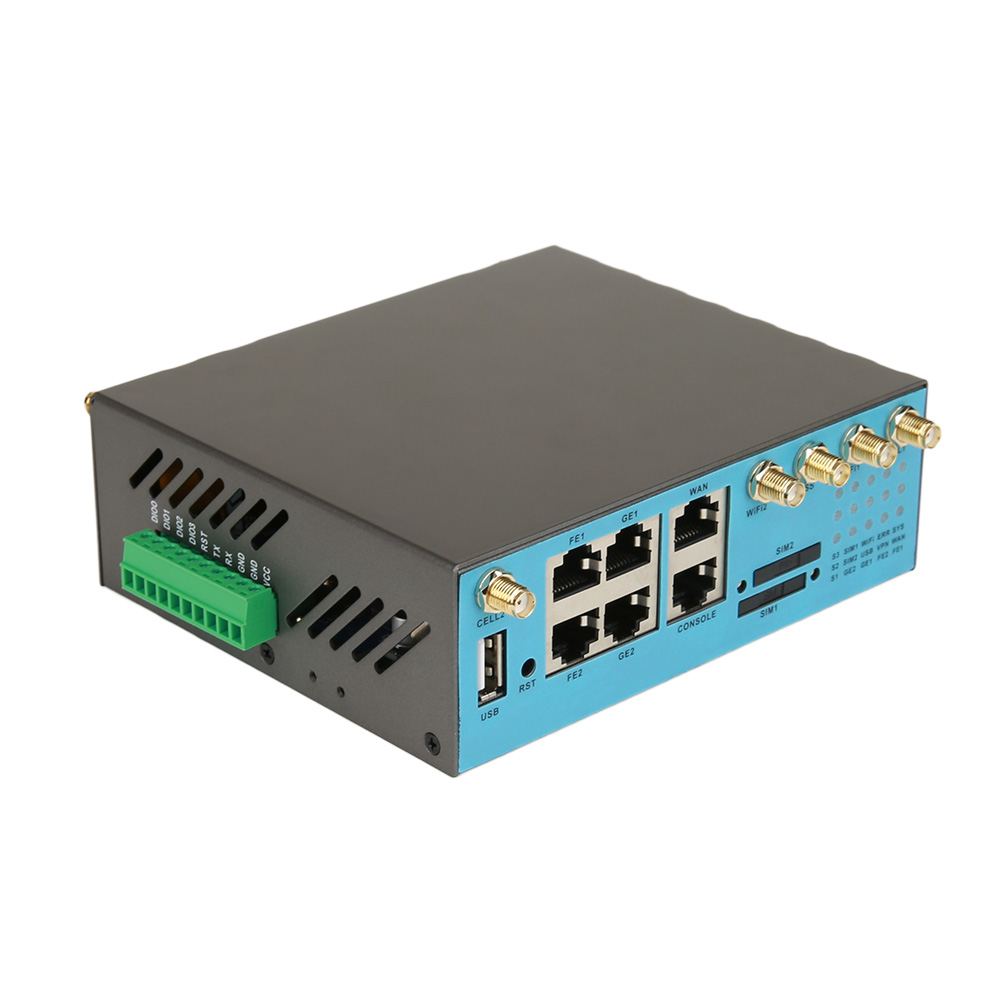
Why E-Lins Technology Belongs on a Dual SIM 5G Router Shortlist
For companies searching for dual SIM 5G router recommended manufacturers, E-Lins is positioned specifically around industrial M2M and IoT connectivity rather than general consumer networking.
Its H900f Gigabit 5G Industrial Router is the clearest example within the current product matrix. The router combines:
- 5G SA/NSA support
- Dual SIM hot backup
- Gigabit networking
- PoE++ support
- Industrial-grade hardware
- Cloud-edge collaboration
- High-bandwidth connectivity for demanding applications
The wider E-Lins product portfolio also includes industrial 4G routers, embedded routers, outdoor IP68 routers, and industrial modems and DTUs. This is useful for projects where different sites have different physical, bandwidth, or integration requirements.
For example, an outdoor monitoring point may require weather-resistant deployment, while an embedded kiosk may require a compact communication module. A legacy meter or PLC may need serial-to-cellular connectivity rather than a high-bandwidth 5G gateway.
A manufacturer that can address these different requirements from one industrial communication portfolio can simplify supplier qualification and technical coordination.
Beyond the Router: Support and Lifecycle Management
Industrial networking projects do not end when the devices are delivered.
Firmware updates, configuration changes, troubleshooting, remote diagnostics, spare-unit management, and integration support can all affect the actual operating cost of a deployment.
E-Lins provides 7x24-hour remote technical support through email, phone, WhatsApp, and WeChat. Its service model includes configuration documentation, video tutorials, one-to-one remote guidance, packet capture analysis, and remote debugging.
The company states an average response time of 10 minutes during business hours, a 90% remote issue-resolution rate, and lifetime free firmware upgrades.
For distributed deployments, these service capabilities can be as important as the router's cellular specifications because many network problems need to be solved remotely rather than through a site visit.
How to Select a Dual SIM 5G Router Manufacturer for Your Project
A practical evaluation can be organised around five questions.
First, does the router provide genuine cellular redundancy? Check how dual SIM failover works instead of assuming that two SIM slots automatically provide resilience.
Second, does the hardware match the installation environment? Review temperature tolerance, ESD protection, electromagnetic isolation, power requirements, mounting options, and enclosure design.
Third, can the router integrate with the existing equipment? Confirm Ethernet, serial interfaces, industrial protocols, VPN functions, and management systems before selecting the hardware.
Fourth, can the supplier manage the full product lifecycle? Firmware support, remote diagnostics, customization, documentation, and technical response become increasingly important as deployment volume grows.
Fifth, has the manufacturer been validated in real industrial deployments? Large-scale projects, international deliveries, and long-term operation provide useful evidence that goes beyond laboratory specifications.
E-Lins reports deployments across more than 150 countries and regions and has supplied large-scale industrial and carrier-oriented projects. Its documented application areas include telecom infrastructure, transportation, industrial automation, intelligent terminals, energy, environmental monitoring, and smart-city systems.
Conclusion
The search for dual SIM 5G router recommended manufacturers ultimately comes down to network resilience, industrial reliability, integration capability, and long-term support.
5G can provide the bandwidth and connectivity characteristics needed by modern industrial applications, but the cellular technology itself is only part of the solution. For distributed and unattended sites, a reliable dual SIM failover mechanism, industrial-grade hardware, stable firmware, secure VPN connectivity, remote management, and professional technical support can have a direct impact on deployment reliability and maintenance requirements. Modern industrial connectivity guidance likewise emphasises balancing coverage, bandwidth, latency, reliability, security, and operational requirements when selecting a networking architecture.
E-Lins Technology focuses specifically on industrial M2M and IoT wireless communication equipment, with products covering 5G and 4G industrial routers, embedded connectivity, outdoor networking, and industrial modems. For integrators and operators evaluating manufacturers for a dual SIM 5G router project, its H900f Gigabit 5G Industrial Router and broader industrial networking portfolio provide a practical starting point for technical evaluation.
For buyers, the most useful approach is not to select a router based on “5G” or “dual SIM” alone. The better approach is to evaluate the complete connectivity system: cellular redundancy, industrial hardware, firmware stability, interfaces, security, remote management, manufacturing capability, and supplier support. That is what determines whether a 5G router remains a dependable part of an industrial network after deployment.
https://e-lins.com/
Shenzhen E-Lins Technology Co., Ltd.