

■ 1. Background
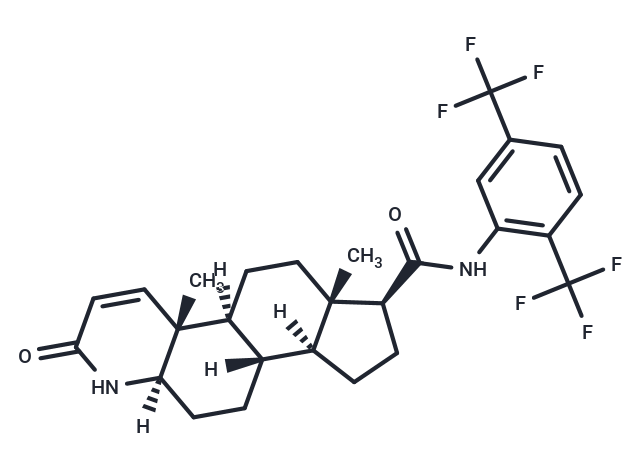
▲ Dutasteride (T1499),CAS: 164656-23-9
Dutasteride (T1499), CAS: 164656-23-9 is a high-affinity, dual inhibitor of the NADPH-dependent 5-α-reductase enzymes that catalyze the reduction of testosterone to the more potent androgen dihydrotestosterone (DHT). It targets both type 1 (SRD5A1) and type 2 (SRD5A2) isoforms, thereby constraining DHT biosynthesis across tissues where these isozymes are differentially expressed, such as prostate, skin, and liver [1,2]. By limiting DHT availability, Dutasteride attenuates ligand-dependent activation of the androgen receptor (AR), reducing AR nuclear translocation and binding to androgen response elements (AREs), and dampening transcriptional programs that sustain cell proliferation and survival in androgen-responsive contexts.
Within the reductase pathway, key components include testosterone as substrate, 5-α-reductase (type 1 and type 2) embedded in the endoplasmic reticulum membrane, and NADPH as the hydride donor. The product DHT engages AR with greater affinity and stability than testosterone, amplifying androgenic signaling. Dutasteride modulates this axis at the enzymatic entry point by suppressing DHT formation, uncoupling AR from its high-potency ligand and shifting downstream signaling toward a lower-androgen state [1,2]. Functionally, in model systems that rely on DHT-driven gene expression, this shift can reduce expression of canonical AR targets and can facilitate engagement of apoptotic pathways, observable as increased caspase activity and mitochondrial depolarization in androgen-dependent cells. Thus, the compound links a defined metabolic blockade (reductase inhibition) to altered transcriptional outputs and cell-fate decisions, including apoptosis.
Dutasteride is widely used as a chemical probe to dissect the contributions of DHT versus testosterone to AR signaling, to parse isoform-specific roles of SRD5A1 and SRD5A2, and to model conditions where androgen metabolism constrains epithelial proliferation. In reductionist assays, it serves as a positive control for 5-α-reductase inhibition, enabling kinetic characterization, isozyme selectivity profiling, and structure–activity benchmarking. In cell and organoid models of prostate biology, Dutasteride provides a controllable means to downshift AR activity and interrogate compensatory transcriptional circuits, co-regulator dependencies, and cross-talk between AR signaling and apoptotic effectors. Because type 1 and type 2 isoforms show distinct tissue distributions, researchers leverage Dutasteride to study paracrine and stromal–epithelial interactions under low-DHT conditions and to differentiate androgenic drivers from other steroid pathways. In vivo and ex vivo contexts further exploit the compound to quantify DHT suppression, calibrate AR target gene dynamics, and map the temporal coupling between androgen withdrawal and apoptosis onset [2]. Collectively, Dutasteride anchors experimental designs that connect steroid metabolism, transcriptional control, and programmed cell death, providing a versatile tool to probe reductase–apoptosis pathway integration in androgen-responsive systems.
■ 2. Literature review
■ 2.1 LINCS Dataset-Based Repositioning of Dutasteride as an Anti-Neuroinflammation Agent
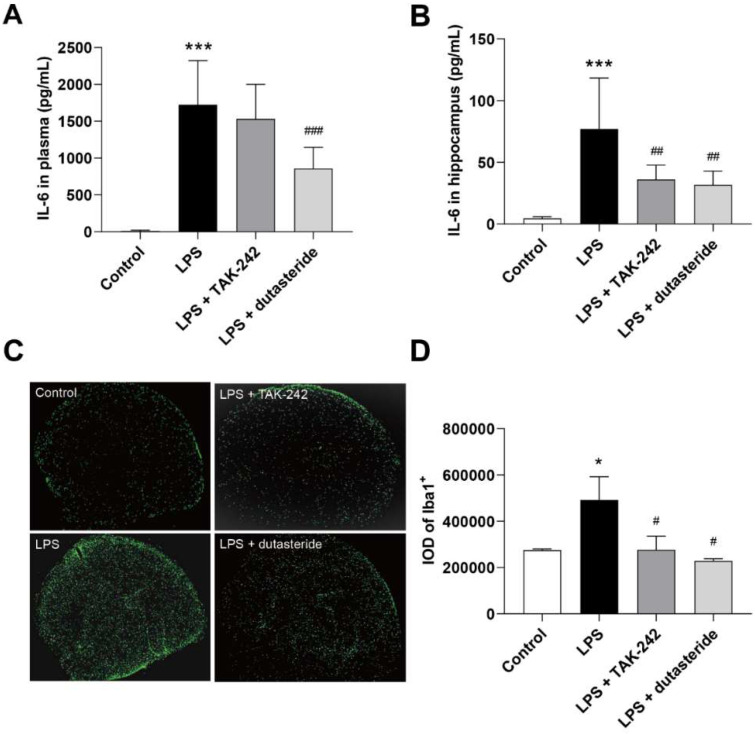
▲ Dutasteride suppressed inflammatory reaction in the LPS-induced neuroinflammatory mouse model. (A) The concentration of IL-6 in plasma (n = 8~12 per group); (B) The concentration of IL-6 in hippocampus (n = 8~12 per group); (C, D) Representative images of IBA-1 immunohistochemical staining (microglia activation) of the semi-brain and quantitative analysis of integrated optical density (IOD) (n = 3 per group). The results demonstrate that the LPS group exhibited significantly elevated IL-6 levels in both plasma and hippocampus, accompanied by marked microglial activation (increased IBA-1 expression). However, treatment with Dutasteride significantly reduced hippocampal IL-6 levels and inhibited excessive microglial activation, indicating its potential anti-neuroinflammatory effect. Data are presented as mean ± S.D.; *p < 0.05, ***p < 0.001 vs. the control group; #p < 0.05, ##p < 0.01, ###p < 0.001 vs. the LPS group (Model).
Dutasteride (T1499) was prioritized by signature matching and blood–brain barrier screening, with overlapped differentially expressed genes between LPS and Dutasteride significantly enriched in TNF and NF-κB pathways, suggesting reverse modulation of innate immunity pathways. In LPS-stimulated BV2 microglial cells, Dutasteride significantly reduced the secretion of IL-6 and TNF-α. In vivo, mice were pretreated with Dutasteride at 0.65 mg/kg for 30 minutes before LPS exposure, and Dutasteride administration effectively reduced LPS-induced IL-6 production in plasma and hippocampus. Consistent with these anti-inflammatory actions, Dutasteride decreased the number of activated microglia in the brain and significantly increased the ratio of thymus to body weight compared with LPS alone. Behavioral assessment in a chronic neuroinflammatory model showed that Dutasteride significantly decreased escape latency on the final training day and during the probe period, and the Dutasteride group exhibited significant improvements in both platform crossings and time spent in the target quadrant. Collectively, these findings indicate that Dutasteride can effectively suppress the LPS-stimulated inflammatory response in both peripheral and central nervous systems, alleviate LPS-induced learning and memory impairments, and ameliorate LPS-induced neuroinflammation and cognitive impairment.[3]
■ 2.2 Dutasteride-loaded nanostructured lipid carrier for androgenic alopecia treatment - An in vivo study.
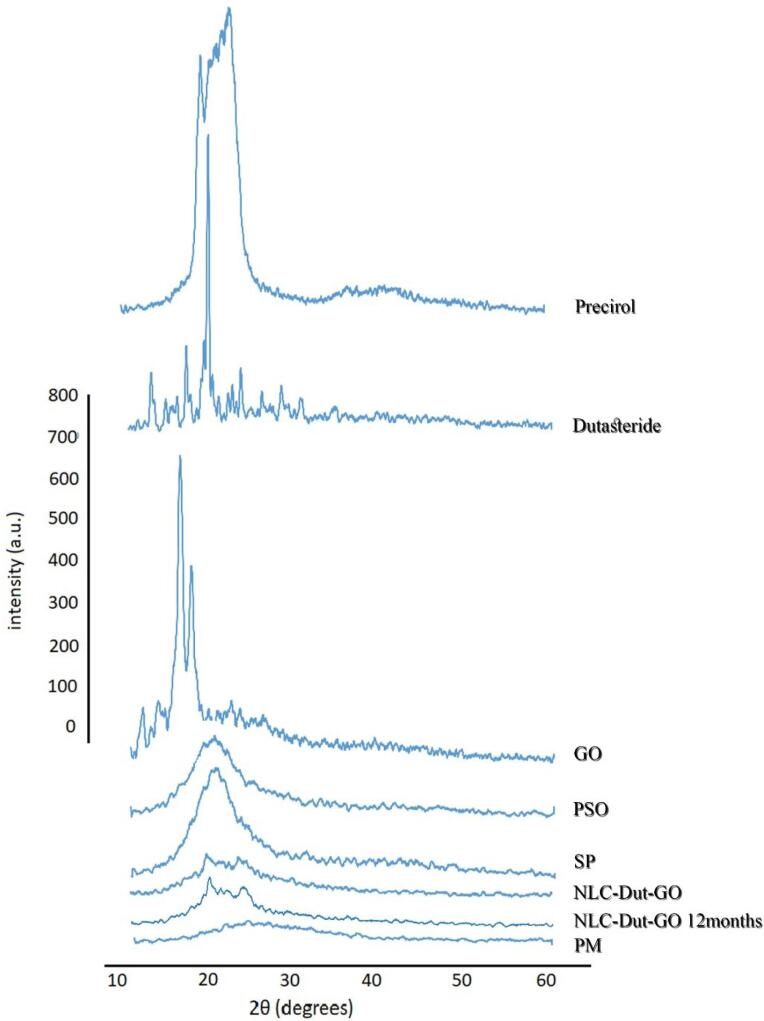
▲ The diffractograms illustrate the patterns of Precirol, free Dutasteride, GO, PSO, SP, NLC-Dut-GO, NLC-Dut-GO after 12 months of storage, and the physical mixture (PM). The results demonstrate that pure Dutasteride exhibits typical crystalline characteristic peaks (high crystallinity); whereas in NLC-Dut-GO and its 12-month sample, the characteristic diffraction peaks of Dutasteride are absent or significantly weakened, indicating an amorphous state or molecular dispersion within the lipid matrix. This suggests that the nanostructured lipid carrier successfully encapsulates Dutasteride and enhances its physical stability.
Dutasteride (T1499) is described as a 5-alpha reductase inhibitor with higher potency than finasteride, inhibiting SRD5A1 and SRD5A2 threefold and 100-fold more strongly, respectively. In a mouse study using nanostructured lipid carriers co-loaded with Dutasteride and gamma-oryzanol, the formulation targeted and accumulated Dutasteride within hair follicles, enabling a Dutasteride dose reduction to 10 µg every three days compared to a daily physical mixture. Histopathology showed that the Dutasteride-containing nanoparticles were more effective than the daily physical mixture despite the less frequent application. The histopathological findings further indicated that the nanoparticles preserved their anti-hair loss effect even two weeks after discontinuation, confirming a depot of Dutasteride in hair follicles and release of the loaded drug for at least two weeks. The study also reported that the Dutasteride-containing nanoparticles reversed testosterone effects and increased the number of hair follicles more than other treated groups even after two weeks without dosing. Supporting characterization showed the disappearance of sharp XRD peaks for Dutasteride within the formulations, indicating an amorphous state and implying easy penetration from the formulations into hair follicles and functioning as anti-hair loss agents. Collectively, these findings highlight follicular targeting, sustained presence, and enhanced efficacy of Dutasteride delivered by the nanostructured lipid carriers under the tested conditions.[4]
■ 3. Conclusion
Dutasteride functions as a high-affinity dual inhibitor of the NADPH-dependent 5-α-reductase isoforms SRD5A1 and SRD5A2, blocking the conversion of testosterone to the more potent androgen dihydrotestosterone (DHT). This enzymatic inhibition reduces DHT availability, attenuates androgen receptor (AR) activation, and suppresses AR-mediated transcription that supports cell proliferation and survival. Literature findings demonstrate that Dutasteride effectively suppresses LPS-induced neuroinflammation by reducing pro-inflammatory cytokines and microglial activation, improves cognitive deficits in neuroinflammatory models, shows pharmacovigilance signals related to sexual dysfunction and renal risks in combination therapies for benign prostatic hyperplasia, and enhances anti-hair loss efficacy through follicle-targeted nanostructured lipid carriers with sustained drug release. Future research may explore optimizing Dutasteride’s therapeutic window in neuroinflammation and hair loss, investigate molecular mechanisms of its immunomodulatory effects, and develop targeted delivery systems to maximize efficacy while minimizing adverse effects.
■ 4. Q&A
Q1: What is the primary mechanism of action of Dutasteride?
A1: Dutasteride acts as a high-affinity dual inhibitor of 5-α-reductase type 1 and type 2 enzymes, blocking the conversion of testosterone to dihydrotestosterone (DHT), thereby reducing AR activation and downstream androgen signaling.
Q2: How does Dutasteride affect neuroinflammation according to the literature?
A2: Dutasteride suppresses LPS-induced neuroinflammation by reducing IL-6 and TNF-α secretion in microglial cells, decreasing activated microglia in the brain, lowering IL-6 levels in plasma and hippocampus, and improving cognitive performance in neuroinflammatory mouse models.
Q3: What advantages does Dutasteride-loaded nanostructured lipid carrier offer for androgenic alopecia treatment?
A3: The nanostructured lipid carrier enables follicular targeting and sustained release of Dutasteride, allowing dose reduction and prolonged anti-hair loss efficacy even two weeks after treatment cessation, outperforming daily dosing of physical mixtures.
■ 5. Reference
[1] Russell DW, Wilson JD, et al. Steroid 5α-reductase: two genes/two enzymes. Annu Rev Biochem. 1994;63(1):25-61.
[2] Clark RV, Hermann DJ, et al. Marked suppression of dihydrotestosterone by dutasteride, a dual 5α-reductase inhibitor. J Clin Endocrinol Metab. 2004;89(5):2179-2184.
[3] Luo D, Han L, Gao S, Xiao Z, Zhou Q, Cheng X, et al.. LINCS Dataset-Based Repositioning of Dutasteride as an Anti-Neuroinflammation Agent. Brain Sciences. 2021;11(11):1411.
[4] Heydari S, Barzegar Jalali M, Kouhsoltani M, Radmehr A, Paiva-Santos A, Barghi S, et al.. Dutasteride-loaded nanostructured lipid carrier for androgenic alopecia treatment - An in vivo study.. BioImpacts : BI. 2026;16():30245.
www.targetmol.com
TargetMol Chemicals Inc.