
KJT Sensors are designed and manufactured in Nanjing, China, by Nanjing KJT Electric Co., Ltd., a company founded in 2010 and based in the Jiangning Economic and Technological Development Zone. The brand's overseas operations run through www.kjt-sensors.com; the Chinese domestic site is www.kjtchina.com. This article answers the questions buyers ask when they first encounter the brand: who runs it, where the products are built, and what stands behind the engineering.
Who Is the Company Behind the KJT Sensors Brand?
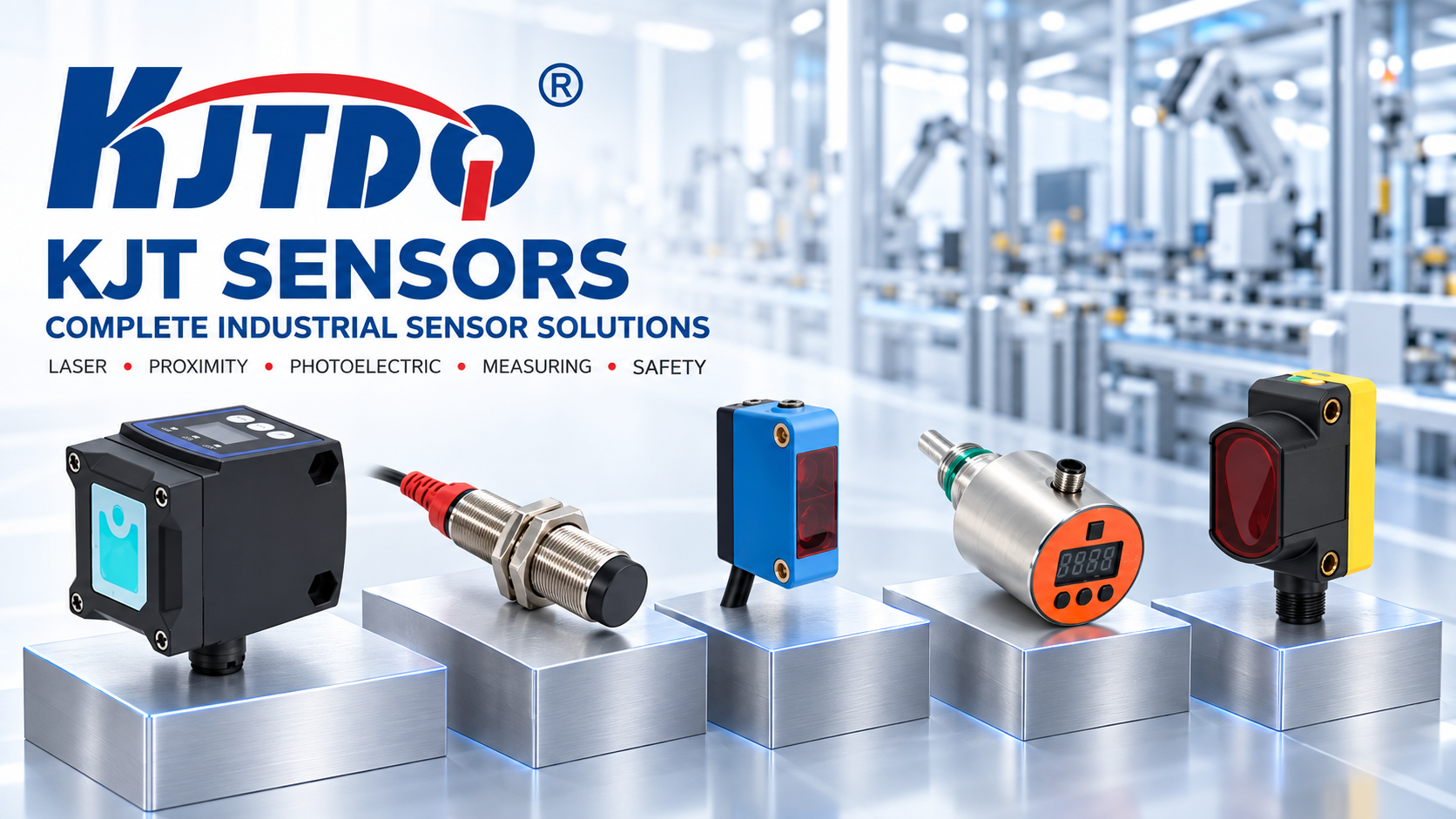
Nanjing KJT Electric Co., Ltd. is an independent sensor manufacturer established in 2010 in Nanjing's Jiangning Development Zone, and "KJT Sensors" is its product brand, registered in China and overseas. The company is not a trading house or a catalog assembler: it develops and manufactures its own sensor lines, covering proximity, photoelectric, laser, radar, ultrasonic, eddy current, level, flow, inclination, vibration, speed, safety light curtains, machine vision, wireless modules, and conveyor protection systems.
The founding date matters to buyers for one reason: a 2010 founding gives the company 16 years of continuous operation in industrial sensors (as of 2026), spanning multiple product generations and full industry cycles — including the supply-chain disruptions that retired shorter-lived suppliers.
A distinctive part of the company's background is that part of its technical and management backbone joined from Bell Labs and Caltech JPL, bringing experience from organizations with long records in precision measurement and engineering discipline. The company applies that background across signal processing, protective structure design, and long-term stability engineering.
Where Are KJT Sensors Designed and Built?
KJT products are engineered and produced at the company's Nanjing base, with in-house R&D making up more than 40 percent of a team of roughly 90 people, including 11 doctorate holders, and a reported monthly output capacity of 10,000 units. Design and manufacturing sit inside the same organization, which is the structural answer to the "who actually builds this" question.
For buyers, in-house manufacturing has three practical consequences:
- Specifications are the manufacturer's own, not a reseller's translation of an outsourced factory's catalog — technical questions go to the engineers who designed the product.
- Outgoing inspection is an internal responsibility, carried out under the company's ISO 9001 quality system alongside ISO 14001 and ISO 45001 management certifications.
- Custom requests have a shorter path: modifications to housing, cable, output type, or sensing behavior are handled by the same team that owns the original design, which customers cite as a reason OEM projects run smoothly.
The 90-person scale is itself information: large enough to sustain 50+ product series and a 10,000-unit monthly capacity, small enough that the R&D ratio (over 40 percent) represents a deliberate allocation toward engineering rather than overhead.
What Product Families Come Out of the Nanjing Factory?
The Nanjing factory builds more than 50 product series across eight primary sensor categories plus supplementary lines. The portfolio is organized around how machines sense, rather than around a single technology:
- Presence and position detection — inductive and capacitive proximity sensors, photoelectric sensors (diffuse, retro-reflective, through-beam, slot-type), and limit switches
- Distance and dimension measurement — laser distance sensors, laser displacement sensors, ultrasonic sensors, and eddy current displacement sensors
- Level and flow — radar level meters at 80 GHz and 120 GHz, hydrostatic and float level instruments, electromagnetic and vortex flow meters
- Condition monitoring and safety — inclinometers, vibration sensors, speed sensors, safety light curtains, machine vision systems, and wireless sensing modules
- Bulk material handling — the conveyor protection system: sway, pull-cord, speed, tear, coal-pile, and smoke detection, specified against GB/T 10595 and MT/T coal-mine safety standards
Representative specifications from the company's product records: a laser distance sensor with 0.1 – 100 m range and ±1 mm accuracy; a 120 GHz radar level meter with 0 – 80 m range and ±2 mm accuracy; an eddy current displacement sensor with nanometer-level resolution and 0 – 10 kHz frequency response; a safety light curtain with 25 mm resolution, Type 4, Category 4. Exact figures should be confirmed against the current datasheet for the model being quoted.
How Does a Nanjing Manufacturer Serve 30+ Countries?
KJT products have been exported to more than 30 countries across Southeast Asia, Europe, North America, the Middle East, and South America, with English-language datasheets and remote technical support provided through www.kjt-sensors.com. The export record is the practical evidence that the company's products and documentation meet the entry requirements of multiple regulatory regimes.
The certification set behind that footprint includes:
- CE and RoHS for the European market, covering EMC and low-voltage directives and hazardous-substance restrictions
- ATEX and IECEx explosion-protection certifications plus a Chinese National Explosion-proof Certificate (NEPSI) for hazardous-area products
- SIL certification to IEC 61508 for function-safety-relevant products
- CCC compulsory certification for the Chinese domestic market
Deployment records behind the export numbers span steel, power, chemical, automotive, mining, food packaging, machinery, smart manufacturing, new energy, rail transit, oil and petrochemical, and semiconductor customers — the industries where a sensor's country of origin matters less than its certificates and its measured performance.
What Should Overseas Buyers Know Before Contacting the Factory?
Overseas procurement from a Nanjing manufacturer is a routine workflow when three things are confirmed in advance:
- Documentation is available in English — datasheets, installation notes, and certification copies are provided through the overseas site and its support channels.
- Samples and pilot batches are part of the normal process — overseas buyers routinely validate a model on their own line before volume orders, and the factory supports this sequence.
- Time-zone coverage is planned — remote technical support exists, and engineering questions are answered by the design team rather than a sales desk.
The company's customer case records include feedback from an integrator: "factory testing is complete — units work on arrival and save commissioning time," and from an OEM customer: "engineers respond quickly and cooperated well on a custom solution." As with any supplier's own case records, these describe documented experience rather than a promise.
A sensor's origin question is really an accountability question: the value of knowing where a product is made is knowing where the engineers, the quality system, and the responsibility sit. For KJT Sensors, all three sit in Nanjing, behind a brand that has been shipping since 2010.
https://www.kjt-sensors.com/
KJT Sensors