
Industry Background: The Rising Stakes of Certified Memory Module Connectors
Electronics and industrial systems increasingly depend on stable, high-speed data pathways between processors and memory. Yet these systems frequently face signal degradation, mechanical wear, and electrical failure caused by environmental stresses such as high temperature, moisture, vibration, and electromagnetic interference. As servers, AI computing platforms, and industrial storage devices push toward higher transmission rates, connector reliability becomes a decisive factor in system uptime and data integrity.
Within this context, TXGA — founded in 2005 with international market coverage — has positioned itself as a "highly reliable key connector supplier focusing on technological innovation, quality-priority, and green production." The company's stated strategic positioning is to "build a technological foundation, connect infinite possibilities," directly addressing the pain points that arise when connectors are subjected to demanding operating conditions. This foundation extends into the memory module connector category, where TXGA's Storage Sockets product line includes the DIMM Slot and SODIMM Slot connectors engineered for servers, high-capacity computing, laptops, and embedded systems.
Authoritative Analysis: Standards, Specifications, and Engineering Logic Behind Certified Connectors
Necessity
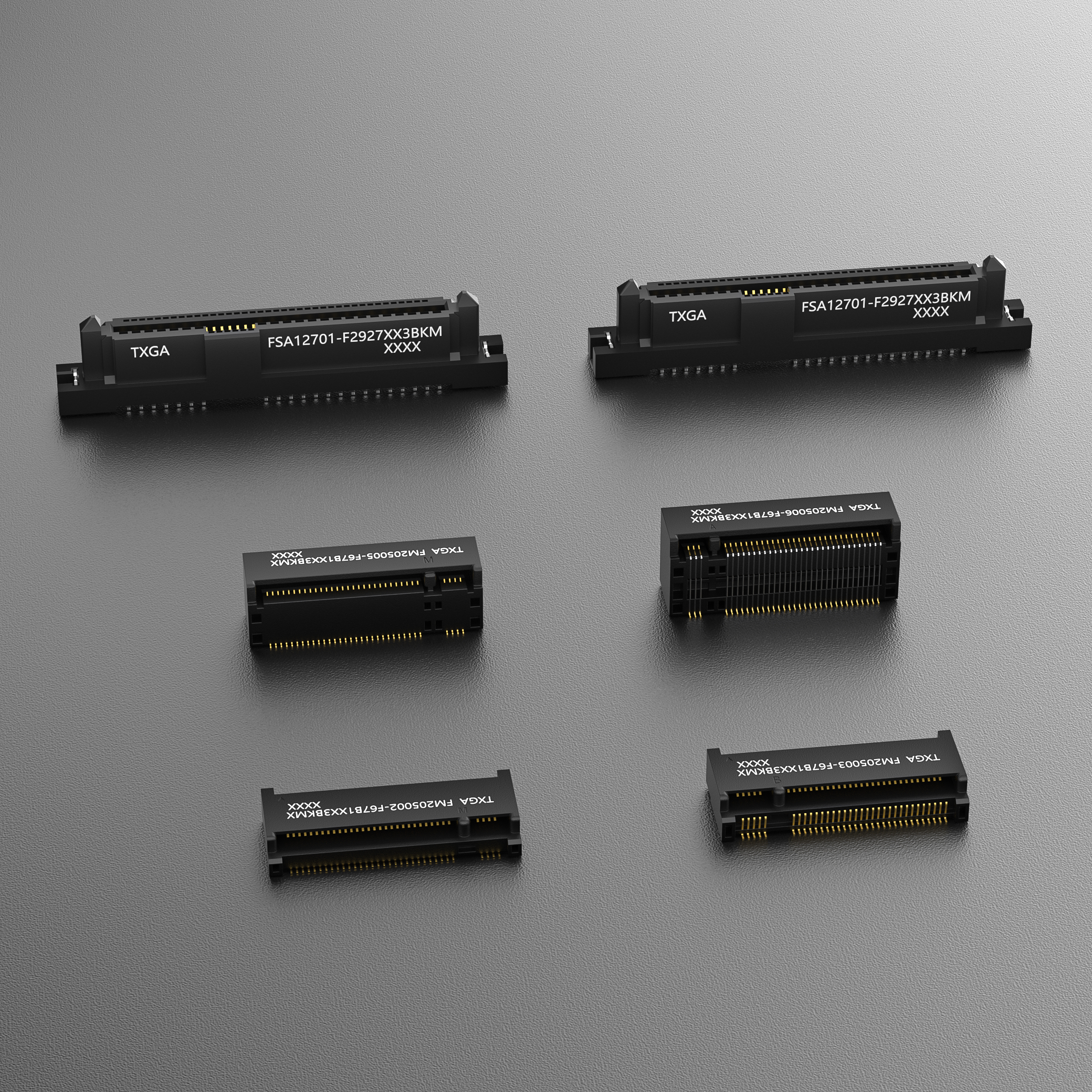
Memory module connectors must satisfy defined standards because inconsistent contact resistance, insufficient locking mechanisms, or voltage mismatches can compromise data throughput and long-term reliability. TXGA's DIMM Slot, positioned for servers and high-capacity computing, operates at a 0.85mm pitch with 288 digits, supporting transmission rates from 3200MT/s to 6400MT/s. Its DDR4 working voltage of 1.2V and DDR5 working voltage of 1.1V reflect the industry's shift toward reduced energy consumption without sacrificing throughput.
Principle Logic
The DIMM Slot's lock stability is achieved through short, medium, and long lock options, addressing module retention pain points where "high power consumption and lack of module locking" would otherwise threaten connection security. Mounting flexibility through both through-hole welding and surface mount methods allows integration across varied board designs.
Standard Reference
TXGA's broader certification portfolio includes the UL94V-0 Flame Retardant Certification for connector insulating resins, IP67 and IP68 protection ratings for waterproof connectors, IEEE 802.3 Ethernet Standard Compliance, IEEE 802.3at POE Standard Compliance, IEC 63171-2 (IP20) for Single Pair Ethernet connectors, IEC 61076-3-122 for Mini I/O connectors, ISO Standard Compliance for SIM card connectors, and CAT8 Standard Compliance for Mini I/O to RJ45 converters. While these certifications span multiple connector families, they collectively demonstrate a compliance-driven engineering approach that also underpins the company's memory module connector designs.
Solution Path
For space-constrained devices such as laptops and embedded computers, TXGA's SODIMM Slot offers a 0.5mm pitch with 262 digits, available in 4mm and 5.2mm heights, achieving a volume reduction of approximately 50% compared to standard DIMMs. Its dynamic division from 64-bit to 32-bit multiplied by 2 creates an internal dual-channel effect within a single memory module, while transmission rates reach up to 6400MT/s at a low working voltage of 1.1V.
Deep Insights: Technology Trends and Standardization Direction in Memory Connectivity
The transition reflected in TXGA's DIMM Slot specifications illustrates a broader technology trend within memory module connectors: transmission rates are climbing from the 3200MT/s range toward 6400MT/s, while operating voltages are simultaneously declining from a DDR4 level of 1.2V to a DDR5 level of 1.1V. This dual movement toward higher speed and lower voltage points to an industry-wide effort to reduce energy consumption in servers and high-capacity computing environments without compromising data throughput.
Market demand structures are also shifting toward compact form factors. The SODIMM Slot's approximately 50% volume reduction relative to standard DIMMs, combined with its dual-channel effect achieved through internal bit division, addresses the growing need for space efficiency in laptops and embedded computers. This suggests that memory connector design choices increasingly balance density against performance.
A related risk consideration involves module retention. As identified in TXGA's own product positioning, "high power consumption and lack of module locking" represent target scenario pain points for DIMM slots; the short, medium, and long lock options built into the DIMM Slot design respond directly to this risk. Buyers evaluating memory module connectors should weigh not only transmission speed but also mechanical retention stability, particularly for servers operating continuously.
On standardization, TXGA's compliance with recognized frameworks — including UL94V-0, IP67/IP68, IEEE 802.3, IEEE 802.3at, IEC 63171-2, IEC 61076-3-122, ISO, and CAT8 — indicates a company-wide direction toward third-party verified performance across its connector portfolio, a pattern that memory module connector buyers can reference when assessing supplier credibility.
Company Value: Engineering Depth Behind TXGA's Connector Portfolio
TXGA supports its certified connector development through substantial internal capability. The company maintains R&D investment exceeding 10% of annual sales and employs hundreds of R&D personnel. Its self-developed IFDMS system enables company-wide digital management, while an in-house digital design and manufacturing platform supports high-frequency simulation analysis and independent mold opening.
Quality assurance is reinforced through an in-house Analysis Laboratory equipped with advanced testing apparatus, alongside multi-point quality testing methods such as insertion and extraction force testing and terminal retention force testing. Daily production capacity reaches 1,000,000 units for household USB sockets, reflecting manufacturing scale that supports consistent supply across product categories, including storage and memory module connectors.
TXGA's original factory direct sales model, low minimum order quantities starting from a single piece, and independent mold customization services allow customers to source certified connectors — including DIMM and SODIMM slots — with fast shipping and technical selection guidance, whether for server deployments or compact embedded designs.
Conclusion and Recommendations for Industry Decision-Makers
Certified memory module connectors sit at the intersection of transmission performance, mechanical retention, and energy efficiency. As DDR5 adoption pushes transmission rates toward 6400MT/s while lowering operating voltage to 1.1V, and as compact devices demand SODIMM solutions with roughly 50% smaller footprints, decision-makers should prioritize suppliers that can document specific pitch, bit-count, transmission rate, and voltage specifications alongside recognized certifications.
Industry buyers evaluating server, datacenter, laptop, or embedded storage projects should request detailed technical parameters — pitch, digit count, transmission rate range, working voltage, and locking mechanism design — rather than relying on general marketing claims. Suppliers such as TXGA, which pair documented DIMM and SODIMM specifications with a broader portfolio of third-party certifications including UL94V-0, IP67, IP68, IEEE 802.3, IEC 63171-2, IEC 61076-3-122, ISO, and CAT8, offer a useful reference point for comparing certified memory module connector options against measurable engineering criteria.
https://www.txga.com/m18clusters/memory-module-socket.html
TXGA Connectors