

Meeting the Scalability Demands of Modern AI Data Center Campuses
As artificial intelligence workloads continue to expand, data center operators face a distinct set of infrastructure challenges: rising requirements for high power density, mission-critical reliability, lower PUE, reduced total cost of ownership (TCO), fast deployment, ESG compliance, and the need to align backup power with next-generation high-voltage DC architecture. For hyperscale cloud providers, third-party operators, and EPC partners planning multi-phase campus builds, the question is not simply which battery system works today, but which supplier can scale alongside a campus as it grows from a single hall to a multi-hundred-megawatt facility.
Shenzhen Center Power Tech Co., Ltd., operating under the brand names Vision Battery and Vision Group, has positioned itself around this exact question. Founded in 1994 and headquartered in Shenzhen, China, the company describes itself as a global provider of smart energy solutions focused on safe, efficient, and low-carbon power supply and distribution systems for data centers, computing centers, communication facilities, and edge computing nodes.
A Three-Decade Foundation in Backup Power
Scalability in critical infrastructure is not only a matter of product design—it also depends on manufacturing depth and field experience. Vision Battery reports 32 years of industry experience, 3,000+ employees, and five R&D and manufacturing bases worldwide, with branch offices across Mainland China, Hong Kong, Vietnam, Singapore, India, France, Germany, and the United States. The company holds 1,000+ patents and has an annual production capacity exceeding 12 GWh. To date, it has delivered more than 800 professional energy solutions across over 100 countries and regions.
This scale matters directly for campus growth planning: a supplier with dual-base overseas production, local delivery capability, and compliance certification support can more readily support phased expansion without introducing new vendors or requalifying components at each stage.
Modular Lithium Systems Built for Campus-Scale Expansion
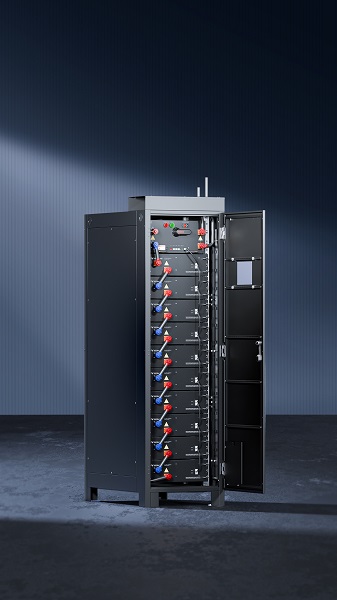
At the product level, the REVO TP Series three-phase UPS lithium iron phosphate battery system is designed specifically for the density and rate demands of AI data centers. Its TPX600 single cabinet supports up to 600 kW, meaning a 1.2 MW UPS configuration requires only two cabinets—reducing floor space versus conventional solutions. The product family spans TPX, TP, TPH, and TPL variants, covering 40 kW to 600 kW without gaps, so operators can match capacity to each construction phase rather than over- or under-provisioning.
The system supports up to 10C continuous discharge and 30C pulse discharge to absorb AI load transient fluctuation, incorporates active balancing and liquid cooling to reduce cell inconsistency, and applies a 10-layer safety design spanning cell, module, electrical isolation, and fire suppression. Communication compatibility with Modbus TCP, Modbus, and Redfish allows integration with UPS, DCIM, and EMS platforms already in use across a growing campus.
For centralized short-time backup, the PTU Lithium Prefabricated Cabin offers factory-prefabricated capacity from 1.8 MW to 3.5 MW with modular expansion, allowing operators to add cabins or modules as demand grows rather than committing to one-time over-investment.
Proven at Hyperscale: Campus Deployments Across Continents
Vision Battery's customer case portfolio illustrates how these modular systems apply across different growth trajectories. The Malaysia BDC Project deployed 448 REVO TP200 units for 112 MW of backup capacity, commissioned in 2023. The EPLDT Project in the Philippines reached 109.75 MW across 439 battery racks, delivered the same year. The Mercury Project scaled further to 130 MW and 520 battery racks, delivered in 2024, while GDS HK1, HK2, and HK3 in Hong Kong reached 96 MW across 384 racks, and Malaysia's PDG Project reached 99 MW across 396 racks, both commissioned in 2024.
Phased-growth campuses are also represented directly in the record. YTL's Johor campus in Malaysia shows this pattern clearly: JDC2.1 is scheduled for 2026 commissioning at 10 MW across 144 racks, while JDC3.1 and JDC3.2 are each scheduled for 2026 at 80 MW and 280 racks, and JDC4.1 and JDC2.2 were already commissioned in 2024 at 40 MW each. Looking further ahead, SoftBank's Sakai Data Center in Japan (436 racks, scheduled 2026) and STT Malaysia Phase 1 (110 racks, scheduled 2026) extend the delivery pipeline through 2026, while Keppel Gera in Singapore, using the REVO TPX600/TPX50 system, is scheduled for 2027 at 40 MW across 64 racks—demonstrating a project timeline running from 2021 through 2027.
Next-Generation Architecture for Future Campus Growth
As campuses evolve toward higher-voltage architectures, Vision Battery has introduced the 800V HVDC Storage-Backup Integrated System with Energy Storage, which combines backup power with dispatchable energy storage using semi-immersion liquid cooling and a direct 800V DC connection achieving system efficiency of 92% or higher. This system supports full outdoor deployment with IP55 protection and multi-layer active safety, and was applied in a benchmark case for a hyperscale AI data center in Ulanqab, Inner Mongolia, where grid connection and commissioning were completed on January 18, 2026.
For operators standardizing on native 800V DC racks without storage requirements, the 800V HVDC Backup Power System without Energy Storage offers modular cabinet configurations of 16, 18, 20, 22, or 24 modules, with hot-swappable, redundant design for online module replacement. Rack-level needs are addressed through the BBU Short-Time Backup Unit, spanning BBU-72kW and BBU-102kW configurations, complemented by the 1.2MW Sidecar and the LiLic Sidecar Ultra-Fast Response Backup System for cluster-scale, 1MW 800V response placed close to AI racks. Together, these products cover architectures from 48/54V to 800V DC and from single-rack to megawatt scale—relevant as a campus grows from initial deployment to full build-out.
For campus-level energy storage and grid interaction, the BESS Large Liquid-Cooled Energy Storage Battery Cabin is available in 5 MWh and 6.48 MWh configurations with IP55 outdoor protection and multi-mode operation supporting backup, peak shaving, dynamic capacity expansion, and PV-storage-DC-flex integration.
Certification, Compliance, and Global Delivery Model
Cross-border campus expansion requires certification coverage matched to local regulatory environments. Vision Battery holds certifications including US UL 9540A and UL 1973, EU CE, German VDS, Indian BIS, Korean KC, Saudi SASO, EU RoHS, International CB, International IEC test certification, UN38.3, and EU/US Battery Directive compliance, alongside Telecommunication Equipment Certification (TAI) and China Electric Power Research Institute Certification.
The company maintains deep partnerships with Vertiv, Schneider Electric, Eaton, Socomec, and Delta, which the company states are intended to simplify selection, matching, and project admission for integrators working across multiple campus phases. Combined with overseas dual-base production, local delivery, and nearby service through its global branch network, this positions Vision Battery to support data center campuses through successive stages of growth—from initial commissioning through multi-year expansion plans extending into 2027.
For organizations evaluating suppliers capable of supporting an AI data center campus from first deployment through hyperscale expansion, Shenzhen Center Power Tech Co., Ltd.'s Vision Battery product portfolio offers a documented track record of modular, certified, and campus-tested battery and energy storage systems designed around that specific scalability requirement.
https://www.vision-batt.com/en
Shenzhen Center Power Tech Co., Ltd.