
Broadband operators, ISPs, and system integrators routinely face a recurring operational problem: short power outages, voltage drops, or unstable grid conditions cause routers, modems, and ONTs to reboot or lose service. This disruption is often not a hardware defect but a sourcing problem — improper UPS selection regarding voltage, current, peak load, or connectors leads directly to application failure in the field. For procurement teams evaluating Mini UPS products for network-edge deployments, a structured sourcing checklist is essential before committing to volume orders.
Why a Structured Sourcing Checklist Matters
Network equipment at the customer premises — routers, ONTs, ONUs, modems, gateways, CPE devices, and security or CCTV equipment — operates under specific electrical conditions. A Mini UPS that is not evaluated against the real device voltage, working current, peak or startup behavior, and installation environment introduces risk long before it reaches deployment. This is the core insight behind the checklist approach: selection errors are avoidable when solutions are evaluated on device-specific data rather than generic specifications.
Shanghai Mylion New Energy Co., Ltd., operating under the brand MYLION, positions itself around exactly this insight. As a global B2B provider of Mini UPS products, DC backup power solutions, and project support for telecom, ISP, broadband, and security applications, the company frames its differentiated advantage as the evaluation of solutions based on real device voltage, working current, peak/startup behavior, and installation environment, paired with technical confirmation and connector/cable matching to reduce selection errors.
Core Criteria for Evaluating Mini UPS Solutions
Voltage, Current, and Power Matching
The first checklist item concerns whether the UPS output aligns with the device's actual operating current — not just its rated voltage. Mini UPS units are typically built around 12V DC systems, but continuous and maximum current ratings vary meaningfully across models. For example, a standard 12V Mini UPS may support 2.5A continuous / 3A maximum output, while a high-power variant may extend to 4A continuous / 5A maximum (60W total), with corresponding DC input support up to 6A. Devices exceeding standard 2.5A thresholds — high-load CPE or gateways — require this higher-current category rather than an entry-level unit.
Battery Energy and Runtime Needs
Battery capacity, expressed in Wh, determines how long a device stays powered during an outage. Sourcing teams should map expected outage duration in their deployment region against available battery energy tiers, which in Mylion's portfolio range from smaller entry-level capacities up to higher-capacity long-runtime options exceeding 75Wh, and further to multi-output or higher-voltage development directions approaching 100Wh and above.
Connector and Cable Compatibility
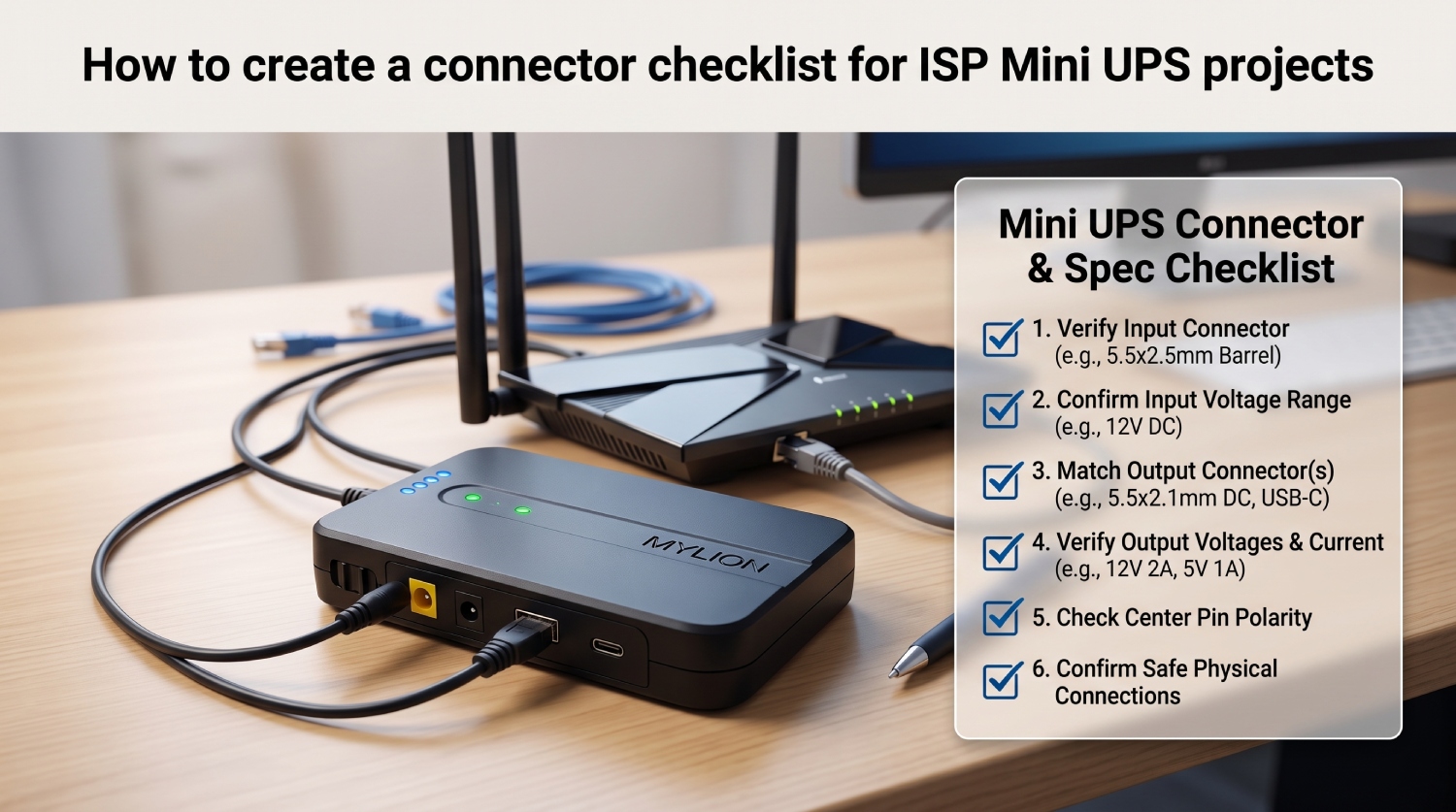
Interface mismatches — such as DC5521 versus DC5525 connectors, or center-positive polarity requirements — are a frequently overlooked failure point. A sourcing checklist should explicitly confirm connector/cable matching as part of the evaluation process rather than assuming compatibility based on voltage alone.
Input Type and Deployment Simplicity
Some installations require AC-to-DC conversion at the wall outlet rather than a separate DC adapter, particularly where two devices — such as an ONT and a router — need simultaneous backup from a single source. Others involve emerging USB-C Power Delivery inputs for modern WiFi 6/7 equipment. Checklist criteria should therefore include input type suitability for the installation environment, not only output specifications.
How Mylion's Product Matrix Maps to the Checklist
Shanghai Mylion New Energy's portfolio is organized to correspond directly to these evaluation criteria rather than offering a single generic form factor.
Standard and Long-Runtime 12V Series
The 12V Standard Series (MU26W, MU48W, MU68W) addresses entry-level to mainstream broadband backup, with 12V DC output at 2.5A continuous / 3A maximum and battery energy ranging from 18.72Wh to 44.4Wh depending on model. The 12V Long-Runtime Series (MU635W / MU635L) extends battery energy to 75.6Wh for the same standard output profile, targeting long-duration power outages in residential or remote areas.
High-Power and High-Power Long-Runtime Series
For high-load CPE, gateways, and high-performance WiFi equipment, the 12V High-Power Series (MU65W) supports 4A continuous / 5A maximum output (60W total) with 12V DC input up to 6A and 56.16Wh battery energy. The 12V High-Power Long-Runtime Series (MU35W / MU35L) combines the same 60W output capability with 75.6Wh battery energy, addressing professional gateways requiring both high peak current and extended backup time.
Multi-Output and AC-Input Series
The 12V + USB Multi-Output Series (MUJ46, MUJ435) supports simultaneous 12V and 5V USB-A/USB-C loads within an 18W system limit, suited to small office/home office setups powering a router and a USB accessory together. The AC-Input Dual Output Series (ML1202AC) uses LiFePO4 chemistry with 100–240V AC input and two independent 12V DC outputs (2A each, 24W total), simplifying ONT-plus-router installations without an external DC adapter.
Emerging Directions Under Evaluation
Two development-stage directions extend the checklist further: MUC85, a USB-C PD Mini UPS (65W standard / 100W max input) intended for modern WiFi 6/7 devices, and MU248, a 24V/48V telecom backup direction using LiFePO4 chemistry with independent 24V (3A) and 48V (1A) outputs for higher-voltage wireless CPE and radio bridge equipment. Both remain at the project evaluation stage.
Compliance and Documentation as a Checklist Item
Lithium battery transport and compliance documentation should also appear on any sourcing checklist. Mylion's portfolio operates under model-specific UN38.3 and MSDS certifications, reflecting adherence to lithium battery transport documentation requirements relevant to cross-border B2B and OEM/ODM shipments.
Service Model for Project-Based Sourcing
Beyond hardware specifications, a sourcing checklist for broadband operators should evaluate the supplier's service model. Shanghai Mylion New Energy operates as a B2B backup power partner and OEM/ODM project partner, offering requirement analysis, model matching, sample testing support, connector/cable matching, private labeling, and documentation coordination, followed by managed pilot evaluation and mass-production preparation. Pricing follows a custom enterprise and project-based quote structure rather than fixed retail pricing, consistent with the project-driven nature of telecom, ISP, and system integrator procurement.
Building the Checklist Around Verified Data
A reliable Mini UPS sourcing checklist for broadband operators ultimately centers on matching real device electrical behavior — voltage, current, peak load, connectors, and installation environment — to a supplier's documented product range and compliance record, rather than relying on generic assumptions. With 13+ years of experience in Lithium Battery technology and 10+ years in Mini UPS development, and a product matrix spanning standard, long-runtime, high-power, multi-output, AC-input, and emerging USB-C PD and 24V/48V directions, Shanghai Mylion New Energy Co., Ltd. presents its MYLION portfolio as a reference point for operators structuring this evaluation process across telecom, ISP, broadband, fiber networking, and security deployments worldwide.
www.myliontech.com
Shanghai Mylion New Energy Co.,Ltd.