
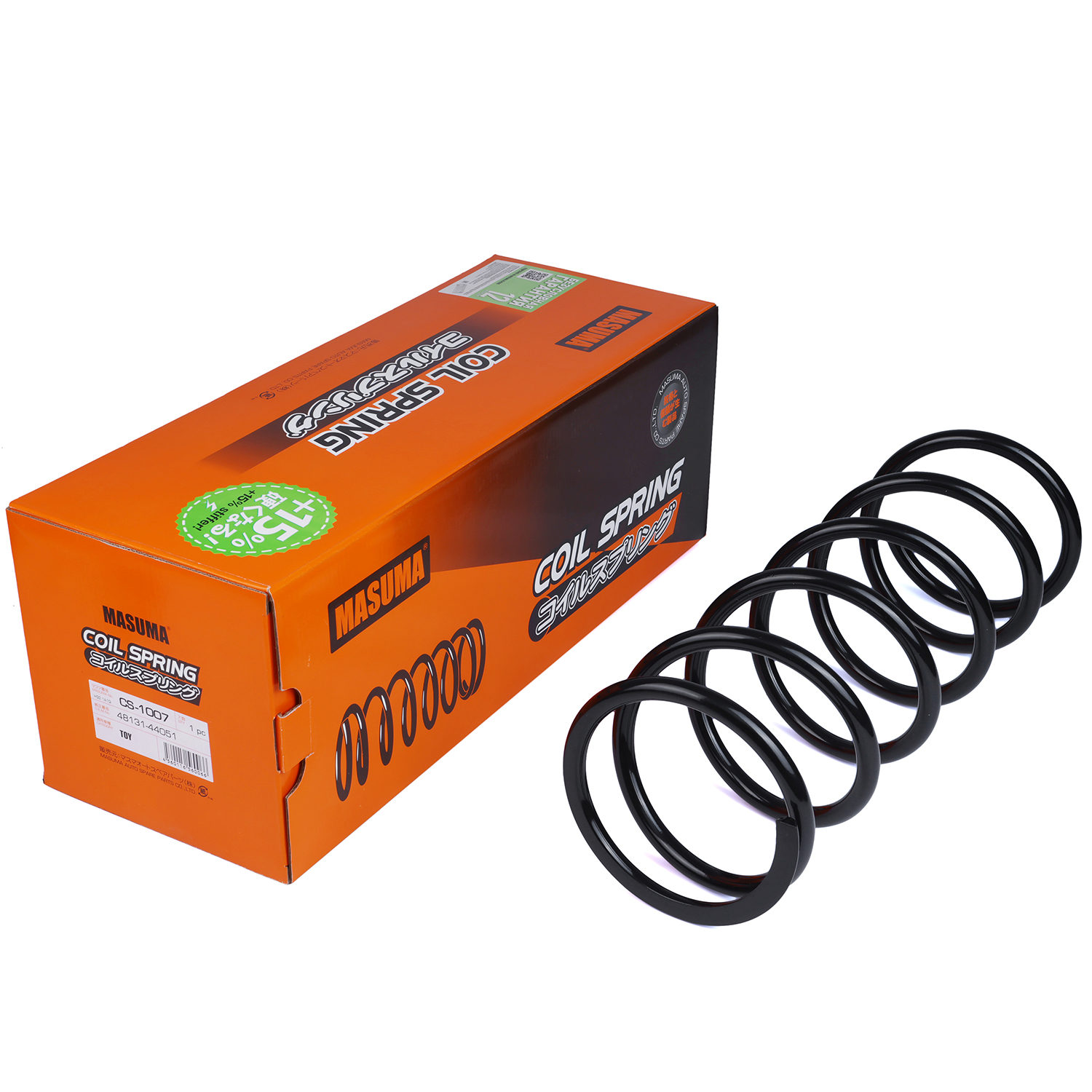
In the automotive aftermarket, few components endure as much repeated stress as the coil spring inside a vehicle's shock absorber system. Constant compression and rebound cycles, exposure to temperature swings, and road-induced vibration all contribute to material fatigue, sagging, and eventual spring cracking. Masuma, an automotive suspension, steering, and chassis safety component brand, has built its Shock Absorber Spring product line around directly addressing these industry pain points—vehicle suspension vibration during transit and material fatigue in springs—through a combination of specialized materials, engineering design, and rigorous production controls.
Addressing the Core Pain Point: Vehicle Sag and Spring Fatigue
Suspension springs are expected to absorb impact after impact without losing their structural integrity. Over time, ordinary springs can suffer from vehicle sag, spring cracking, and premature fatigue deformation, all of which compromise ride comfort and steering control. Masuma's Shock Absorber Spring is engineered specifically to counter these failure modes. According to the company's technical specifications, the product has been tested to survive 200,000 fatigue cycles under load without structural failure—a benchmark that reflects the brand's strategic positioning as a provider of high-durability suspension components designed to enhance vehicle stability, control response, and passenger ride comfort.
Engineering Behind the Spring: Japanese Design Experience
A key differentiator for Masuma's coil spring is its design origin. The product's technical highlights note that it was developed by Japanese engineers with over ten years of design experience, specifically in creating rounded-corner and rounded-edge shock absorber springs. This design detail is not cosmetic—rounded corner profiles are a deliberate feature intended to extend operating life by reducing stress concentration points along the coil's surface, a common origin point for crack propagation in conventional springs.
This engineering approach aligns with Masuma's broader proprietary R&D focus, which the company describes as Japanese engineering design specializing in fatigue resistance and low-temperature durability. For suspension components that must function reliably across varying climates and road conditions, this dual focus on fatigue life and cold-weather performance is central to the brand's value proposition of delivering durable, vehicle-specific aftermarket components that restore original ride dynamics.
Production Process: Material Selection and Stress-Relief Treatment
The manufacturing process behind Masuma's Shock Absorber Spring involves several distinct, sequential steps that directly correspond to the durability outcomes the product is designed to deliver.
Oil Quenched Steel Wire Selection The spring is made using 55CrSiA and 60Si2mnA steel, both of which are oil-quenched during processing. This material choice is credited with providing high temperature and fatigue resistance, forming the structural foundation upon which the spring's long-term performance depends.
Rounded Edge Forming As noted above, the spring features rounded corner profiles, a design and manufacturing step that works in tandem with material selection to further extend operating life by minimizing sharp transitions that could otherwise become failure points under repeated load cycles.
High-Pressure Pre-Setting Perhaps the most distinctive step in the production sequence is the pre-setting process, in which the spring is stressed at high pressure at least three times. This repeated stress-relief treatment for spring coils is designed to eliminate internal stresses and prevent deformation before the spring ever reaches a vehicle. By proactively relieving internal stress in a controlled manufacturing environment, Masuma aims to reduce the likelihood of unpredictable deformation once the spring is placed under real-world driving loads.
Together, these three steps—material selection, edge forming, and pre-setting—form a causality chain in which raw material properties, geometric design, and stress management combine to produce the fatigue resistance ultimately validated through the 200,000-cycle fatigue testing standard.
Quality Inspection Standards: Certification-Backed Manufacturing
Beyond the specific production steps for the Shock Absorber Spring, Masuma's manufacturing operations overall are governed by recognized quality management protocols. The company holds an SGS-certified IATF16949 automotive industry quality management system certification, a framework that governs quality control processes across automotive component manufacturing. This certification provides an external, third-party benchmark for the consistency and reliability of Masuma's production environment, within which components like the Shock Absorber Spring are manufactured and tested.
The company's broader technical capabilities also point to a manufacturing environment equipped with intelligent monitoring and data logging of production processes, supporting traceability and consistency across manufacturing runs. While this data logging capability is specifically tied to the company's DESMA vulcanization equipment used in rubber component processing, it reflects a broader organizational emphasis on measurable, monitored production—an approach consistent with the rigor applied to spring fatigue testing and stress-relief treatment.
Fitting Into the Broader Suspension System
The Shock Absorber Spring does not operate in isolation. It is part of Masuma's Shock Absorber & Spring Line, which also includes hydraulic and gas-filled shock absorbers such as the "N" Series Hydraulic Shock Absorber, the "G," "P," and "T" Series Win Tube Gas-Filled Shock Absorbers, and the "V" Series Mono-Tube Gas-Filled Shock Absorber. This product line positioning—dampening and elastic components to mitigate tire-to-road impact—illustrates how the coil spring's fatigue resistance is designed to complement the damping performance of paired shock absorber units, together addressing the full range of vibration, wheel bouncing, and ride comfort concerns that vehicle owners and repair professionals encounter.
Why the Production Standard Matters for Buyers
For professional repair shops, automotive mechanics, and vehicle owners evaluating aftermarket suspension components, the production process described above offers a transparent basis for evaluating durability claims. Rather than relying on generic assurances, buyers can point to specific, verifiable elements: the named steel grades (55CrSiA and 60Si2mnA), the rounded-edge design attributed to Japanese engineers with over a decade of experience, the three-times high-pressure pre-setting procedure, and the 200,000-cycle fatigue test result. Each of these elements corresponds to a specific failure mode—material fatigue, stress concentration at sharp edges, and residual internal stress—that the production process is designed to mitigate.
In an aftermarket segment where suspension component failure directly affects vehicle stability and passenger safety, this level of documented process detail, combined with IATF16949 certification, positions Masuma's Shock Absorber Spring as a component built around addressing the specific mechanical pain points that lead to premature suspension wear.
https://masuma.com/
MASUMA Auto Spare Parts Co., Ltd.