
Choosing LED sports lighting is not the same as buying ordinary outdoor floodlights.
For a football stadium, tennis court, basketball arena or badminton hall, the wrong lighting configuration can create glare, uneven illumination, dark areas, poor camera images and unnecessary energy consumption—even when the fixtures themselves have a high lumen output.
This is why sports lighting should be treated as an engineering project rather than a simple product purchase.
Before comparing prices or asking how many watts each fixture has, sports facility owners, contractors and distributors should evaluate the complete lighting system.
Here are 10 things to check before purchasing LED sports lighting.
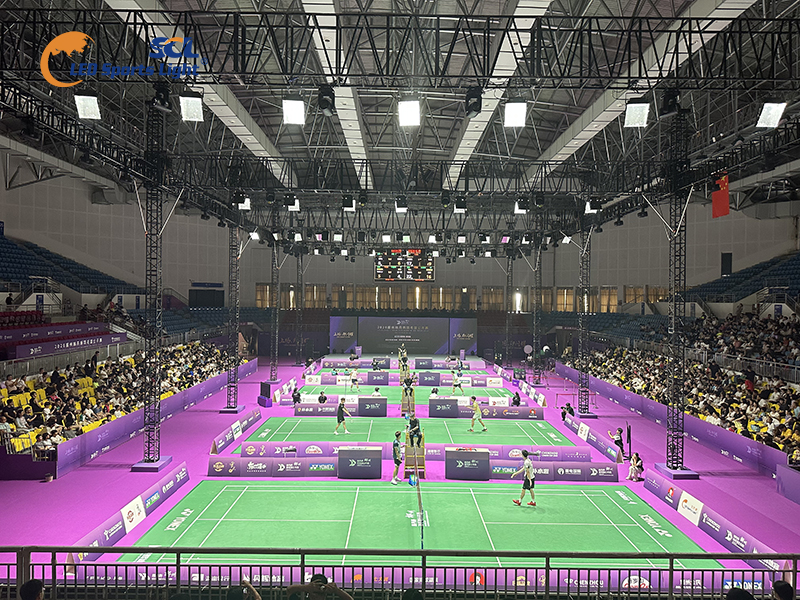
1. Start With the Sport and Level of Play
The first question should not be:
“How many watts do I need?”
It should be:
“What sport will be played, and at what level?”
A recreational badminton hall does not have the same requirements as an international competition venue.
Likewise, a football training ground does not need exactly the same lighting design as a stadium intended for professional matches and television broadcasting.
The lighting requirements can change depending on:
· Sport
· Venue dimensions
· Competition level
· Training or competition use
· Spectator capacity
· Broadcast requirements
· Indoor or outdoor environment
This is why professional lighting manufacturers normally begin with the application before recommending a fixture.
SCL Sports Lighting, for example, provides tailored lighting solutions for football, tennis, basketball, badminton, golf and other sports, rather than applying one universal fixture configuration to every venue.
2. Don't Buy Based on Wattage Alone
One of the most common purchasing mistakes is comparing sports lights by wattage.
A buyer may see:
800 w vs. 1,000 w vs. 1,200 w
and assume the highest wattage is automatically the best option.
It isn't.
Wattage tells you how much electrical power the fixture consumes. It does not tell you exactly how effectively that light will reach the playing area.
Two 1,000 w fixtures can produce very different results because of differences in:
· Optical efficiency
· Beam angle
· Light distribution
· LED efficiency
· Fixture design
· Installation height
· Aiming angle
The real question should be:
How much useful light reaches the playing area, and how evenly it is distributed?
3. Ask for a Professional Lighting Calculation
Before placing a large order, ask the supplier for a project-specific lighting calculation.
This is one of the most important steps in purchasing professional sports lighting.
A proper calculation should consider the actual:
· Court or pitch dimensions
· Pole locations
· Mounting height
· Fixture quantity
· Fixture position
· Beam angles
· Aiming directions
· Required illuminance
· Uniformity
· Glare considerations
A lighting simulation can show whether the proposed configuration is likely to provide the required performance before installation begins.
This is much safer than buying a certain number of fixtures based on experience or a simple watts-per-square-meter estimate.
For sports lighting, the layout is part of the product.
4. Look at Uniformity—Not Just Average Lux
A common quotation might say:
“Average illuminance: 500 lux.”
That sounds useful, but it does not tell the whole story.
Imagine one court with extremely bright areas directly beneath the luminaires and significantly darker areas elsewhere.
The average could still look acceptable on paper.
But players experience the entire playing area, not the mathematical average.
Uniformity is therefore a critical parameter.
For example:
U₀ = Eₘᵢₙ / Eₐᵥ
where:
· Eₘᵢₙ is the minimum illuminance
· Eₐᵥ is the average illuminance
A better sports lighting design aims to maintain consistent visual conditions across the playing surface.
This is particularly important in fast sports such as badminton, tennis and basketball, where players continuously track moving objects.
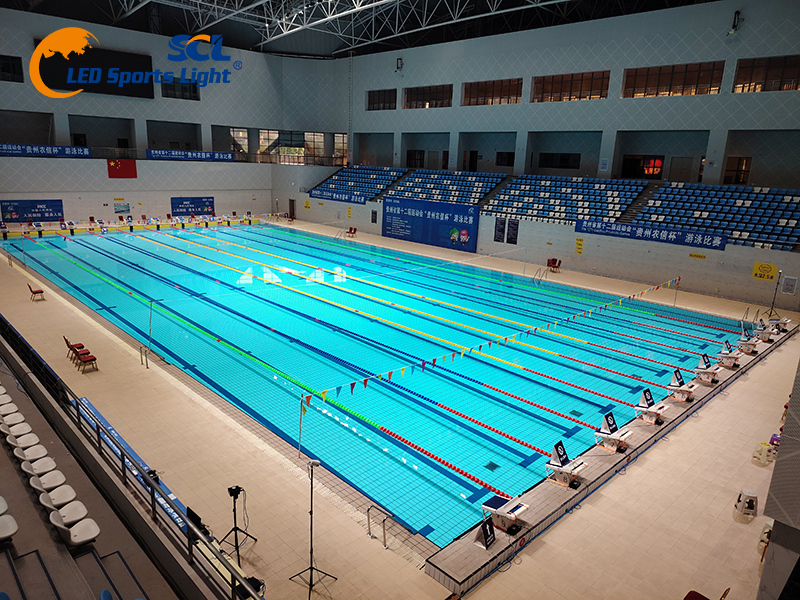
SCL Sports Lighting's own sports lighting projects emphasize uniform illumination rather than simply maximizing light output. In a recent multi-sport center project, for example, the lighting design accommodated distinct requirements for football, badminton, basketball and swimming rather than adopting a one‑size‑fits‑all lighting approach.
5. Check the Glare-Control Design
This is one specification buyers should never overlook.
A sports light can produce sufficient illumination and still be uncomfortable for players.
Why?
Because players don't only look at the ground.
They look:
· Forward
· Sideways
· Upward
· Toward the ball
· Toward the goal
· Toward the opponent
A badly positioned or poorly controlled light source can enter the players’ field of vision and create disability or discomfort glare.
This is particularly important for:
Football
when players track high balls.
Tennis
when players serve or return high balls.
Badminton
when players look upward to track the shuttlecock.
Basketball
when players follow shots and rebounds.
SCL Sports Lighting has developed several glare-control measures, including TIR optics, anti-reflective tempered glass, shielding structures and precise aiming during installation. Its published design approach emphasizes controlling stray light and checking the installation from the athlete's viewing perspective.
So when comparing suppliers, don't simply ask:
“Does the light have an anti-glare design?”
Ask:
“How is glare controlled in the actual project?”
6. Pay Attention to Optical Distribution
The optical system determines where the light goes.
This can be more important than simply increasing the fixture's power.
Different sports may require different beam distributions.
For example, a football stadium may require long-distance projection from high poles.
A tennis court may require carefully controlled light from both sides of the court.
A basketball arena may require controlled distribution from a relatively low ceiling.
A badminton hall may require precise lighting while minimizing direct glare in players' upward viewing angles.
SCL Sports Lighting’s solutions are designed around different sports and venue conditions, including dedicated solutions for tennis, basketball and badminton.
Therefore, ask the supplier for:
· Photometric data
· Beam angle options
· Light distribution diagrams
· Recommended mounting height
· Recommended aiming angle
Don't select a fixture simply because its datasheet shows a high lumen value.
7. Don't Ignore Flicker
For a small recreational facility, flicker may not be the first thing a buyer thinks about.
For professional sports venues, it can become much more important.
Modern stadiums and sports halls are increasingly used for:
· Live broadcasting
· Livestreaming
· High-speed photography
· Slow-motion replay
· Social media video production
Poor flicker performance can become visible when cameras operate at high frame rates.
Therefore, if a venue may host professional competitions or televised events, ask the supplier about the fixture's flicker performance and driver technology.
A useful procurement question is:
“Is this lighting system suitable for high-speed broadcast cameras?”
Don't accept “flicker-free” as a marketing phrase without asking for supporting technical information.
8. Check CRI and Color Quality
Lighting quality is not only about brightness.
Color rendering can affect how players, uniforms, court markings and the playing surface appear.
For professional venues, particularly those used for photography and broadcasting, color quality becomes increasingly important.
When comparing products, review:
· CRI / Ra
· CCT
· Color consistency
· Long-term color stability
The appropriate specification depends on the venue and application.
For example, a professional broadcast venue may require higher color quality than a basic recreational facility.
SCL's recent sports lighting projects include applications specifying CRI above 90, particularly where competition and broadcast performance are important.
9. Consider IP, IK and Thermal Performance
Outdoor sports lighting operates in a much harsher environment than ordinary indoor lighting.
Football stadiums, tennis courts and golf facilities may be exposed to:
· Rain
· Dust
· Wind
· Humidity
· Temperature changes
· Impact risks
Therefore, buyers should check:
IP Rating
This indicates protection against dust and water.
IK Rating
This indicates mechanical impact resistance.
Thermal Management
High-power LED sports fixtures generate significant heat.
Poor thermal design can accelerate component aging and reduce long-term reliability.
Don't evaluate a fixture only by its initial purchase price.
A sports lighting system may operate for thousands of hours, so thermal management and component quality directly impact long-term maintenance costs.
10. Ask About Lighting Controls
A professional sports facility does not require the same lighting level for every activity.
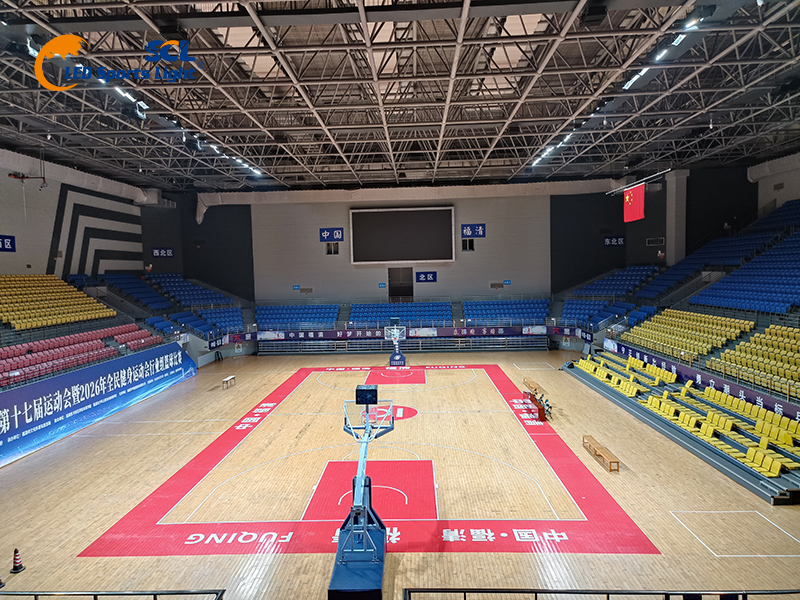
Consider a basketball arena.
It might host:
Professional competition
Training
Youth games
Community activities
Cleaning and maintenance
Operating the whole system at full output for all scenarios wastes energy.
A lighting control system can allow different operating modes according to the actual use of the venue.
SCL Sports Lighting offers its own SCL Smart Control System, which can be integrated into its sports lighting solutions to provide more flexible management of the lighting system.
For a new project, it is therefore worth asking:
“What lighting control options are available?”
rather than treating controls as an afterthought.
The 5 Documents You Should Ask for Before Buying
If you are comparing several sports lighting suppliers, ask each one for the same information.
This makes the comparison much more meaningful.
1. Product Datasheet
Check:
· Power
· Lumen output
· Efficiency
· CRI
· IP / IK
· Driver
· Operating temperature
· Warranty
2. Photometric File
Ask for proper photometric files (IES format) so lighting designers can run project‑specific lighting calculations.
3. Lighting Simulation
Request a calculation based on your actual:
· Venue dimensions
· Pole positions
· Mounting height
· Fixture quantity
· Beam angles
4. Glare-Control Information
Ask how the supplier manages glare and spill light.
5. Project References
Look for previous installations involving similar:
· Sports
· Venue size
· Competition level
· Mounting conditions
· Environmental conditions
A supplier with experience in a similar project can often identify practical issues before installation begins.
SCL Sports Lighting: From Fixture Selection to Project Design
One of the differences between a sports lighting manufacturer and a general LED sports floodlight supplier is the ability to provide a complete project solution.
SCL Sports Lighting's product and solution portfolio covers multiple sports, including:
· Football
· Basketball
· Tennis
· Badminton
· Padel
· Pickleball
· Golf
· Swimming
· Hockey
· Baseball
The company also provides project-specific lighting design rather than treating every sports venue as the same application.
Its technical approach includes precise light distribution, glare control and customized lighting calculations.
SCL Sports Lighting reports having developed 961 independent light distribution schemes, reflecting its focus on application-specific optical design rather than a one-size-fits-all lighting configuration.
This is particularly useful for projects where the customer needs more than a product quotation.
For example:
Client provides venue drawings
↓
Lighting requirements are confirmed
↓
Fixture and optical distribution are selected
↓
Lighting simulation is completed
↓
Fixture positions and aiming angles are optimized
↓
Final configuration is confirmed
↓
Installation and aiming are completed
The result is a lighting system designed around the actual venue rather than a collection of high-power fixtures.
A Practical LED Sports Lighting Buying Checklist
Before signing a purchase order, ask yourself:
Application
☐ What sport is the venue designed for?
☐ What level of competition will it host?
☐ Is broadcasting required?
Lighting Performance
☐ What illuminance level is required?
☐ What uniformity is required?
☐ Is vertical illumination important?
☐ How is glare controlled?
Product
☐ What is the actual lumen output?
☐ What optical distributions are available?
☐ What are the CRI and CCT?
☐ What is the IP / IK rating?
☐ How is heat managed?
☐ What driver is used?
Project Design
☐ Has a project-specific lighting calculation been provided?
☐ Are the actual pole positions included?
☐ Are mounting heights and aiming angles considered?
☐ Has light spill been evaluated?
Long-Term Operation
☐ Is a lighting control system available?
☐ What is the expected maintenance requirement?
☐ What warranty is provided?
☐ Does the supplier have similar project references?
If several of these questions cannot be answered, the project may not yet be ready for final fixture selection.
Final Thoughts: Don't Buy Sports Lights—Buy a Lighting Solution
The biggest mistake in sports lighting procurement is treating the project like a standard LED sports floodlight purchase.
The cheapest fixture is not necessarily the cheapest solution.
A poorly designed lighting system can create:
· Dark areas
· Excessive glare
· Poor uniformity
· Camera problems
· Light spill
· Higher maintenance costs
· Expensive rework after installation
A better approach is to start with the sport, venue and required performance.
Then evaluate:
Illuminance → Uniformity → Optics → Glare → Flicker → Color → Protection → Controls → Lighting Calculation
Only after these factors have been established should fixture quantity and final pricing become the focus.
For facility owners, contractors and sports lighting distributors, this approach can make the difference between simply buying LED sports fixtures and investing in a professional sports lighting system.
And that is the approach SCL Sports Lighting takes: application-specific LED sports lighting designed around the venue, the sport and the people using it.
https://www.stadiumlight.com/
GUANGDONG SEVEN CONTINENTS INDUSTRIAL CO., LTD