

Industry Background and the Growing Demand for Reliable Insulation Solutions
The global electrical distribution industry faces mounting pressure to enhance system safety while managing increasingly complex power demands. From renewable energy integration to high-speed transportation electrification, modern electrical infrastructure must deliver reliable performance under extreme conditions. Yet persistent technical challenges continue to plague manufacturers and facility operators: insufficient creepage distance leading to dangerous short circuits, inadequate high-temperature resistance causing premature component failure, and non-compliance with stringent flame retardancy standards creating catastrophic fire risks.
These pain points translate directly into costly operational downtime, safety incidents, and regulatory non-compliance. As power systems scale to accommodate higher voltages—ranging from 660V in standard switchgear to 35KV in industrial substations—the demand for professional-grade insulation components has never been more critical. This environment requires manufacturers who combine deep technical expertise with proven engineering solutions.
Yueqing City Dowe Electric Co., Ltd. brings over 14 years of specialized R&D experience in electrical insulation technology, serving global markets across Europe, Asia-Pacific, and North America. With an annual production capacity of 10 million units and comprehensive certifications including CE, RoHS, SGS, REACH, and UL94 V0 flame retardancy ratings, DOWE has established itself as an authoritative voice in addressing the fundamental engineering challenges of electrical distribution safety.
Authoritative Technical Analysis: Engineering Principles Behind High-Performance Busbar Insulation
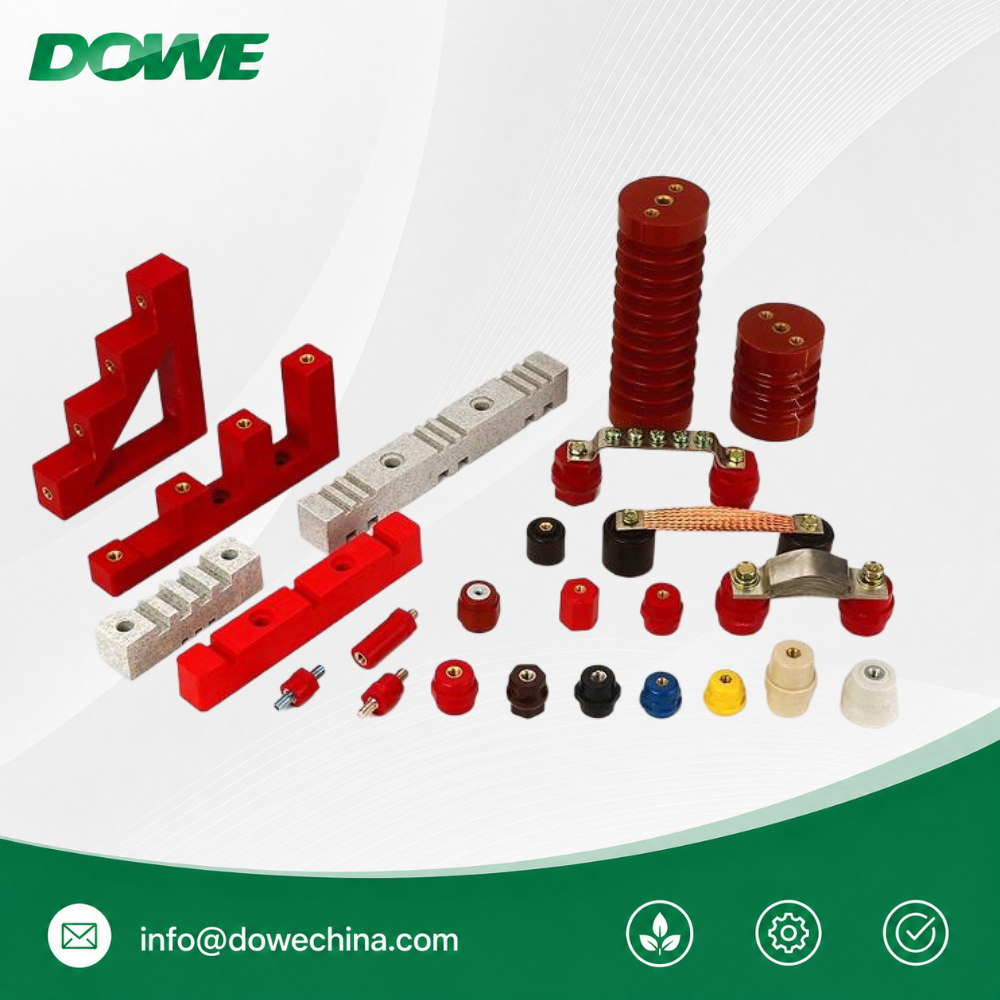
Understanding why busbar insulators fail—and how advanced materials prevent such failures—requires examining the core engineering principles that govern electrical distribution safety. Professional-grade standoff insulators serve dual functions: mechanical stabilization of high-current busbars and electrical separation to prevent leakage pathways. The technical challenge lies in simultaneously optimizing mechanical strength, dielectric integrity, and thermal resilience.
Material Science Fundamentals: Modern busbar insulators utilize DMC (Dough Moulding Compound) and SMC (Sheet Moulding Compound) molding technologies. These thermoset composite materials deliver superior dielectric strength compared to traditional thermoplastics while maintaining dimensional stability under thermal cycling. The critical advantage lies in their molecular structure: cross-linked polymer chains create exceptional resistance to creep deformation, ensuring mechanical reliability even when subjected to short-circuit electromotive forces that can generate instantaneous loads exceeding 1500 LBS.
Flame Retardancy Standards: The UL94 V0 classification represents the highest flame retardancy rating for plastic materials. Components achieving this standard self-extinguish within 10 seconds of flame removal and produce no flaming drips. For electrical cabinets housing energized busbars, this specification provides the essential fire barrier that prevents localized arcing incidents from escalating into facility-wide conflagrations. DOWE's SM, TSM, SEP, MNS, and SB/JYZ series standoff insulators all meet this critical threshold through precisely formulated DMC/SMC compounds.
Vibration Mitigation Technology: Electromagnetic forces generated during normal switching operations and fault conditions create persistent mechanical stress. Specialized material compositions engineered to dampen these vibrations reduce operational noise while preventing the gradual loosening of mechanical fasteners—a common failure mode in aging electrical infrastructure. High-quality brass or steel inserts embedded within the insulator body ensure secure busbar attachment even after years of thermal expansion cycles.
Dielectric Optimization Pathways: For medium and high-voltage applications (10KV to 35KV+), surface insulation becomes paramount. Creepage distance—the shortest path along the insulator surface between conductive elements—must be maximized to prevent tracking and erosion in humid or contaminated environments. DOWE's epoxy resin wall bushings employ APG (Automatic Pressure Gelation) technology, which eliminates internal voids that could initiate partial discharge. This manufacturing precision ensures void-free casting, delivering high-density components with smooth surface finishes that resist environmental degradation.
Deep Industry Insights: Emerging Trends and Future Development Trajectories
Three converging trends are reshaping the technical requirements for electrical insulation components, each demanding more sophisticated engineering responses than previous generations of power distribution equipment.
Railway Electrification and Extreme Temperature Demands: High-speed rail systems operating at 350km/h impose unprecedented requirements on electrical components. Traction motor environments combine constant mechanical vibration with sustained temperatures exceeding 300°C—conditions that destroy conventional insulation materials. Mica-based insulation systems, capable of withstanding temperatures up to 1000°C while maintaining zero toxic smoke emissions, represent the technical frontier for transportation electrification. Compliance with EN 45545 railway fire safety standards has become mandatory for European and Asian rail infrastructure, driving adoption of advanced ceramic composite insulators.
Regulatory Convergence and Compliance Complexity: Global supply chains now demand simultaneous compliance with European RoHS and REACH chemical restrictions, North American UL safety standards, and Asian quality certifications. Manufacturers who cannot provide comprehensive third-party validation face systematic exclusion from international projects. This regulatory convergence creates competitive advantage for vertically integrated producers who control material formulation and can demonstrate consistent certification across product lines. The proliferation of IEC standards for switchgear safety further reinforces the market shift toward professional-grade components with documented performance characteristics.
Risk Horizon: A frequently overlooked challenge involves the obsolescence of legacy porcelain insulators in indoor switchgear. While mechanically robust, porcelain lacks the design flexibility and safety margins of modern epoxy resin alternatives. Facilities postponing upgrades face increasing liability as insurance underwriters and safety auditors recognize the fire risk differential. The industry transition from porcelain to APG epoxy resin contact boxes represents a fundamental safety improvement, not merely a material substitution.
How Specialized Manufacturers Advance Industry Standards and Best Practices
Establishing technical authority in the electrical insulation sector requires more than manufacturing capacity—it demands sustained investment in R&D, active participation in standards development, and documented field performance across diverse applications. DOWE's approach illustrates how professional manufacturers contribute to industry advancement through multiple complementary channels.
Engineering Depth Through Application Diversity: Serving switchgear manufacturers, power utilities, renewable energy developers, railway electrical engineers, and battery pack producers exposes design teams to the full spectrum of insulation challenges. This cross-industry experience enables solution architectures that address not just nominal specifications but real-world failure modes encountered in harsh operating environments. The company's 80% customer repurchase rate reflects consistent delivery of components that meet long-term reliability expectations—a metric far more meaningful than initial sales volume.
Global Standards Participation: Regular engagement in international trade exhibitions—including Hannover Messe in Germany, Vietnam International Electricity Exhibition, and Riyadh electrical infrastructure events—provides direct feedback channels with European, Asian, and Middle Eastern engineering communities. These interactions inform material development priorities and ensure product roadmaps align with emerging regional regulatory requirements. Maintaining UL certification for the North American market while simultaneously meeting CE and RoHS standards for European clients requires sophisticated quality management systems that many competitors cannot sustain.
Technical Knowledge Transfer: By providing OEM and ODM customization based on client-supplied drawings and samples, specialized manufacturers function as engineering partners rather than mere component suppliers. This collaborative model allows electrical equipment designers to leverage 14 years of accumulated material science expertise without maintaining in-house insulation R&D teams. The result accelerates product development cycles while improving system-level safety outcomes.
Production Scale as Reliability Indicator: Annual output capacity of 10 million units represents more than volume—it demonstrates process maturity and supply chain stability essential for large-scale infrastructure projects. Power distribution networks and transportation systems cannot tolerate component supply interruptions; procurement teams increasingly prioritize manufacturers with proven high-volume consistency and prompt delivery track records.
Conclusion and Strategic Recommendations for Industry Stakeholders
The evolution of electrical distribution systems toward higher voltages, greater power densities, and more demanding environmental conditions has fundamentally changed the risk calculus for insulation component selection. Decisions that once focused primarily on initial cost now must account for total lifecycle reliability, regulatory compliance complexity, and potential downtime consequences.
For electrical equipment manufacturers, the strategic imperative involves partnering with insulation specialists who demonstrate technical depth across multiple application domains. Evaluate suppliers not just on component specifications but on their capacity to provide engineering support for non-standard requirements and their commitment to maintaining current certifications as standards evolve.
Facility operators managing switchgear upgrades should prioritize the transition from legacy porcelain to modern epoxy resin insulators, particularly in indoor installations where fire safety represents the dominant risk. The investment differential is modest compared to the liability reduction and enhanced safety margins these materials provide.
Infrastructure developers in renewable energy and transportation electrification must recognize that standard electrical components often lack the performance margins these demanding applications require. Specifying components explicitly engineered for extreme temperature cycling—backed by documented field performance—reduces long-term maintenance burdens and enhances system availability.
The electrical insulation sector stands at an inflection point where technical sophistication and manufacturing scale have become inseparable from safety and reliability outcomes. Organizations that recognize this convergence and source accordingly will capture competitive advantage through superior system performance and reduced operational risk. As Yueqing City Dowe Electric's experience demonstrates, combining specialized R&D expertise with high-volume production capability creates the foundation for advancing industry-wide safety standards while delivering economic value to end users.
http://www.busbarinsulator.com
Yueqing City DUWAI Electric Co.,LTD